On “history should make us uncomfortable” and the November 3, 2026 midterm elections in the USA today

Posted: October 31st, 2026 | No Comments »
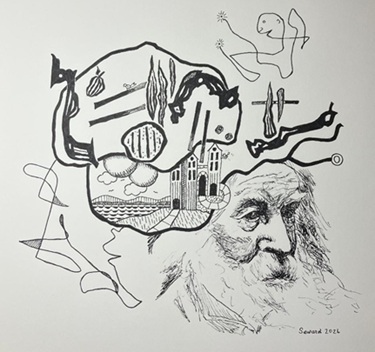
Michael Seward, Untitled. 2026.

RANDALL WHITE, NORTH AMERICAN NOTEBOOK, TORONTO. FRIDAY, OCTOBER 31, 2026. The US midterm elections on which so much about the future of American politics has lately seemed to depend are now just a few days away — on Tuesday, November 3, 2026.

Along with many others in Canada (currently embarking on its future relationship with the European Union, from the pioneering Canadian transcontinental fur-trade metropolis of Montreal), I too am deeply fascinated by where some wider world will be on, say, the late afternoon of November 4. (Eastern Standard Time in New York City, or early afternoon in Los Angeles, on up to northern BC or down south to Baja California and beyond.)

(1) “Harvard’s Drew Gilpin Faust says history should make us uncomfortable”

Drew Gilpin Faust in days now long gone by — Growing Up at Midcentury.

Strictly by chance I have also been catching up on my New York Review of Books reading lately. I have just finished a piece by Drew Gilpin Faust — “known as a historian, a civil rights activist and the first woman president of Harvard,” but “groomed to become a proper Southern lady.”

The piece is adroitly headlined “The Slave’s Power … Two recent books employ inventive approaches to read against the grain of the archive left by those who defended and benefited from human bondage.”

This of course is not the kind of American history Donald Trump likes, as his battle against the Smithsonian Institution underlines. As a summer 2023 National Public Radio piece succinctly explained : “Harvard’s Drew Gilpin Faust says history should make us uncomfortable.” Donald Trump does not want to be made uncomfortable.

His reasons are petty at best. Yet for better or worse many of the 77 million American Trump voters of 2024 may not want to be made uncomfortable by their history as well, for far less petty reasons. And on this ground at least I can have some sympathy with at least some of them. (Who really may have, four years later in the midst of much else in their personal lives, just forgotten the latest darkest times of US federal government and politics, in 2017, 2018, 2019, and 2020.)

(2) On not wanting to be made uncomfortable but still wanting realistic history

Drew Gilpin Faust much more recently, writing about “ our American experience”.

Even personally, I read and enjoy reading and otherwise trying to grasp a lot of history by many excellent historians of one brand or stamp or style or another. I don’t find that this makes me uncomfortable. And I don’t want it to make me feel that way either.

Unlike Donald Trump and some or even many of his 2024 voters, I do want the history I try to digest to be about some version of the real world as lived in by most people. And this real world is, I agree, a complex and often contradictory place.

Along with their great and beautiful human instincts, human beings for whatever reasons can also indulge in unpleasant, disagreeable, bizarre, appalling, and even wicked behaviour.

To me good history is about the real world, and it helps us deal with both the good and bad that lurks in the minds of men (and certainly women too).

(3) Wanting a history that makes us want to do better

To me as well, however, the quest for realism in human history is not the same as searching for stories that might make me feel uncomfortable. I don’t see being uncomfortable as some kind of virtue. And having now read her very good review of two recent books on the history of American slavery I don’t think Drew Gilpin Faust finally does either. In the deep end, as it were, she just believes in the same kind of historical realism that I and many others do.

United Auto Workers on the march.

At the same time, I can see, I think, how telling friends and colleagues at Harvard and in other similar circles that good “history should make us uncomfortable” may qualify as memorable and good enough advice. For some it can be a noteworthy way of alluding to the kind of real-world history that can tell us useful things about the present and future of humanity.

But I think I can also see how some altogether sensible people who live in quite different worlds from that of what President Lyndon Johnson from Texas liked to call “the Harvards” might believe a history that makes us feel uncomfortable is not finally a good thing for the country.

What we all seriously want on this view is a history that makes us want to do better — that includes eg a Civil War fought to at least start to end the long and altogether appalling ordeal of African American bondage in the slave states of the American Republic born in 1776. A history that just promotes some unenergetic uncomfortable state of mind is not going to do the trick.

(4) Worrying about what may or may not happen on Tuesday, November 3, 2026

On the Republican campaign trail 2026.

Somewhere in the middle of such thoughts, induced by Drew Gilpin Faust’s very good New York Review piece on two recent books about “The Slave’s Power” lie my personal worries about what may or may not happen in the USA today on Tuesday, November 3, 2026.

I would very much like to see the Republican party finally taken over by Donald Trump and now (very badly and ineptly ) running the US presidency for a second terrible time, and effectively running the US congress for at least the second Trump Republican presidency’s first two years, handed an unmistakable major and massive 2026 midterm electoral defeat of historic proportions.

I’m still not quite or even at all convinced, however, that this is what will actually have happened by the late or early afternoon of November 4.

But in this respect at least I’d be pleased to be disappointed.

How 2026 Alberta Referendum looks on northwest shore of Lake Ontario

Posted: October 23rd, 2026 | No Comments »
Pincher Creek in southern Alberta — “Jewel of the Rockies”.

RANDALL WHITE. HOME AND NATIVE LAND. FERNWOOD PARK, TORONTO. FRIDAY, OCTOBER 23, 2026. As of noon today, not all the more than 5,500 polling stations involved in this past Monday’s complex 10-question Alberta referendum have reported. But results for 99.4% are now available on the CBC’s “Alberta referendum live results” site. And the main contours of what has happened are clear enough.

On the big question 10 — “Should Alberta remain a province of Canada …” — there is now no doubt that more than 2 million of the more than 3.1 million eligible voters (some 66% or almost two-thirds) have turned out. And a decisive three-quarters majority (finally exactly 75.0%) have declared they want to remain in Canada (as opposed to “hold a binding provincial referendum on whether or not Alberta should separate from Canada”).

(1) Evaluating the result on the crucial question 10 — “Remain or Referendum”?

Put another way, only one-quarter of the two-thirds of eligible Alberta voters actually voting want their province to hold a separatist referendum.

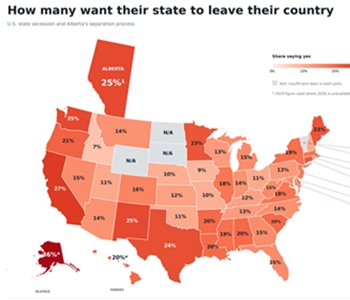
In evaluating this result it seems worth noting that, according to recent YouGov polls, two US states (Alaska and California) show greater percentages (36%, 27%) who “want their state to leave their country,” while five additional states (Washington, New Mexico, Texas, Minnesota, and Maine) show similar percentages to Alberta in Canada on October 19, 2026 (23%–25%).

Similarly, the one-quarter of participating Albertans who chose “referendum” rather than “remain”in 2026 comes nowhere near the 40.4% of Quebecers who voted for “sovereignty” in 1980, to say nothing of the 49.4% who similarly voted in 1995. (Albeit in both cases even in francophone-majority Quebec the exact referendum questions included some form of continuing “association” with Canada!)

Moreover, as Prime Minister Carney has stressed, Canada is a democracy. And a three-quarters vote is a quite decisive democratic majority of participating Albertans who have stood up boldly and unambiguously for their continuing Canadian citizenship. Like many who live in the Great Lakes region of Canada, I am suitably and happily impressed (if hardly surprised) by this strong Canadian result in Wild Rose Country.

Read the rest of this page »

Is the Canadian referendum in Alberta at all as important as what the Houthis in Yemen are doing to Saudi Arabia in Donald Trump’s Middle East?

Posted: October 17th, 2026 | No Comments »
Michael Seward, Untitled 2026.

RANDALL WHITE. GLOBAL VILLAGE NOTEBOOK. FERNWOOD PARK, TORONTO. FRIDAY, OCTOBER 16, 2026. To start with (and very briefly), note the complex referendum in the staunch Canadian province of Alberta this coming Monday, October 19, 2026.

I will say only that if I were living in Edmonton (or Calgary) — as I am not at the moment but happily could be — I would vote exactly as, I take it, Ms Wenda Toews did recently by mail. (See the ballot posted at the end below.)

Now on to a more crucial global issue : Who are the Houthis and what is Yemen in the turbulent Middle East?

* * * *

“Supporters of Shiite Houthi rebels attend a rally in Sanaa, Yemen, in 2017. AP Photo/Hani Mohammed, File”.

According to the Hindustan Times : “It was the third attack on Riyadh’s airport in less than a week, and the deadliest. On October 10th the Houthis, an Iran-backed Shia militia, struck it with missiles. Witnesses said the missiles scored a direct hit on Terminal 3.” A day later the Yemeni rebels carried out a fresh attack on Terminal 4, causing a fire. Saudi Arabia looks increasingly under siege.

Or as Al Jazeera has wondered : “Why are the Houthis striking Saudi airports? … The attacks mark one of the most significant disruptions to Saudi civil aviation in years and the deadliest assault on Saudi soil in more than a decade.”

In response to queries within my own household, I have been recently exploring the related questions of just who are the Houthis and what is Yemen.

Starting with what is Yemen, just looking at a map you might wonder why there is any border between the two Arab countries of Saudi Arabia and Yemen. Yet Yemen has a long separate history. More recently it was divided into the Yemen Arab Republic or North Yemen and the People’s Democratic Republic of Yemen or South Yemen.

Read the rest of this page »

More early autumn 2026 : mass protests in Paris, Rio, etc ; Anne Carson wins Nobel Prize in Literature ; leaving British monarchy in Quebec (& rest of Canada)

Posted: October 10th, 2026 | No Comments »
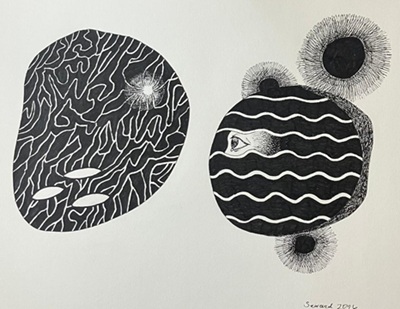
Michael Seward, Untitled 2026.

RANDALL WHITE, CANADIAN REPUBLIC NOTEBOOK. TORONTO. FRIDAY, OCTOBER 9, 2026. In my wider universe focused on the northwest shore of Lake Ontario, in the Great Lakes region of North America, three particular public events have marked the first full week of October 2026 — (1) Youth (and other) protests in France, Brazil, and beyond ; (2) 2026 Nobel Prize in Literature awarded to Canadian/Icelandic writer Anne Carson ; and (3) “Injunction filed to force incoming PQ government [in Quebec] to take oath to King.”

(1) Youth (and other) protests in France, Brazil, and beyond

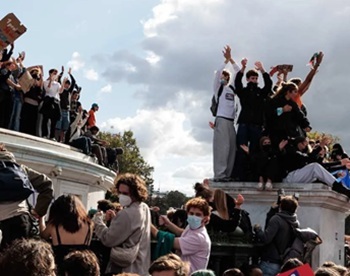
Even in the 2020s the France that gave the wider world the French revolution in the late 18th century, and then the 1848 springtime of the peoples and the 1871 Paris Commune, can suddenly reappear, alive again.

“Students stand on the July Column during a high school and college student protest at Place de la Bastille in Paris … October 8, 2026. Gauthier Bedrignans / Hans Lucas via Reuters Connect.”

See, eg : “URGENT: Police are clashing with protesters in Place de la Bastille in Paris” ; “IT’S TOTAL WAR AT BASTILLE! VERY HEAVY POLICE CHARGE AFTER NUMEROUS PROJECTILE THROWS” ; and “FRENCH STUDENT: ‘More resources for education. Our demand is institutional … A breakaway left. We want to change the system.’”

As has often happened in the past again, the French example has inspired or at least parallelled similar mass protests elsewhere. In the early autumn of 2026 see eg : “Hundreds of students, inspired in part by student unrest in neighboring France, took to the streets of the eastern Belgian city of Liège … Belgian students clash with police over tuition hikes” ; and “LONDON | Solidarity with the high school student movement … Rally at the French embassy … ”

Read the rest of this page »

Oct 5 election results update :What if Paul St-Pierre Plamondon’s Parti Québécois wins 2026 Québec provincial election ??

Posted: October 2nd, 2026 | No Comments »
Michael Seward, Untitled. 2026.

RANDALL WHITE. HOME AND NATIVE LAND. FERNWOOD PARK, TORONTO. FRIDAY, OCTOBER 2, 2026. [UPDATED OCTOBER 6, 2026.} This coming Monday, October 5 la belle province will hold a general election to choose members of its 44th National Assembly (Assemblée nationale du Québec, finally following the nomenclature of the Assemblée nationale in France).

[Scroll below for October 6 update on election results.]

(1) Can Quebec Liberals finally nudge out Parti Québécois in 2026 … probably not ??

I have just noticed two in some ways quite different polls on the coming Quebec provincial election. The first (Pollara, somewhat older) suggests PQ (Parti Québécois) 29% ; PLQ (Liberals) 22% ; CAQ (Coalition Avenir Québec, the present government) 21% ; PCQ (Conservatives) 17% ; QS (Québec solidaire — as seen from the Ontario wilderness a party for hardcore left-wing francophone nationalists) 10% .

By DerHabs – Own work, CC BY-SA 4.0

The second poll (Sondage Pallas Data, somewhat more recently) suggests a quite different ultimate victor : PLQ 32% ; PQ 29%, ; CAQ 14% ; PCQ 14% ; QS 11%.

Despite the Liberals’ first-place finish here, however, most even recent polls I’ve seen have the Parti Québécois standing first — and even possibly with a majority of seats in the Assembly (and thus a majority government), won with less than a third of the province-wide popular vote. (Thanks to five at least strong enough parties competing in a “first-past-the-post” election.)

Read the rest of this page »

Stirrings in early autumn US breeze — Kristol on friendship with Canada, Reich on EU joined by Canada, Japan, South Korea, Australia, New Zealand

Posted: September 25th, 2026 | No Comments »
Michael Seward, Untitled 2026.

RANDALL WHITE, NORTH AMERICAN NOTEBOOK, TORONTO. FRIDAY, SEPTEMBER 25, 2026. Two recent Twitter/X postings by two eminent US commentators suggest some deeper rumblings in Donald Trump’s America in the early autumn of 2026.

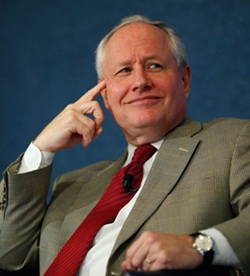
The first comes from William “ Bill” Kristol. He currently describes himself as “Editor at large, The Bulwark ; Director, Defending Democracy Together ; Host, Conversations with Bill Kristol ; Never Trump.” He has only a few months ago been described by C. Douglas Golden in The Western Journal as a “neocon, publisher, and one-time Republican operative extraordinaire” who has now declared “today I’m a Democrat.”

I was first struck by a Kristol post from a few days ago : “I found watching Trump’s UN speech today deeply depressing. It is a matter of national shame and humiliation that he is our president. Every country in the world, friend and foe alike, sees we are governed by a vainglorious fool.”

Bill Kristol, former Republican guru and now Never Trump, who has lately turned into a Democrat.

From here I was intrigued to come across Bill Kristol’s eight-point policy for Democrats in the US midterm elections this November 3 — “1. Stop the data centers ; 2. Make AI safe ; 3. Protect your health care ; 4. Fix the rotten Supreme Court ; 5. Get us out of the Middle East ; 6. Renew our friendship with Canada ; 7. Hold the oligarchs accountable ; 8. Release the Epstein files.”

Sitting here in front of my still newish Dell PC, only a hundred yards or so from the northwest shore of Lake Ontario, I was particularly impressed by “6. Renew our friendship with Canada.” In contemplating the likelihhood of any such thing in any near future I was further impressed by a still more recent post from the more traditional left-wing, long-term Democrat (and former Bill Clinton labor secretary), Robert Reich.

Reich wrote : “I spent much of this week talking with foreign officials who are in the U.S. for United Nations meetings … Here’s what I learned:

Read the rest of this page »

Why deeper Canada-Europe ties have such broad public support in Canada : “EU is viewed positively by 71% of Canadians .. United States? Just 21%”

Posted: September 19th, 2026 | No Comments »
Michael Seward, No title, 2026.

RANDALL WHITE. HOME AND NATIVE LAND. FERNWOOD PARK, TORONTO. FRIDAY, SEPTEMBER 18, 2026. As long ago as 1930 Harold Innis, author of The Fur Trade in Canada : An Introduction to Canadian Economic History (still the most interesting and single best — if not exactly easiest to read — book on any kind of Canadian history) began the conclusion of his local classic with :

“Fundamentally the civilization of North America is the civilization of Europe.” And the main broad “interest” of Innis’s pioneering Canadian fur-trade study of 1930 was “primarily in the effects of a vast new land area on European civilization.”

You might almost guess that somewhere along the line both PM Carney and some among his own updated new/old Ottawa officialdom have lately been reading the conclusion to Harold Innis’s first big book on the “northern North American” resource economy themselves.

And it seems reasonable enough that in the third decade of the 21st century a country of this sort would be graced by an offer to become the first “associate member” of the European Union.

(1) “Carney says Parliament will vote on EU partnership”

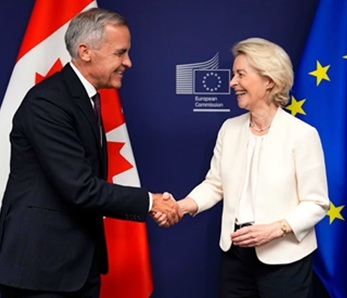
Ursula von der Leyen, President of the European Commission greets Canadian PM Mark Carney in Europe.

The exact nature of this “associate member”status (proposed by Ursula von der Leyen, “President of the European Commission”) inevitably remains for the moment not entirely clear.

Yet it seems likely that a Canada which became the first of the new breed (Australia and New Zealand, other EU figures have suggested, would soon follow) could help define any such status practically.

In any case we happily need not worry about such details for the moment : “Carney says Parliament will vote on EU partnership” in the soon enough fullness of time.

Meanwhile, who can deny the symbolic power already in the transatlantic air; eg, “Spanish Prime Minister Pedro Sánchez posted an image of the EU flag with a red maple leaf beside it Thursday morning.”)

Read the rest of this page »

O Canada on September 11, 2026 .. if only our media were as smart and strong as PM Carney .. and most Canadian people

Posted: September 12th, 2026 | No Comments »
“Electro-Magnetic Love” by Michael Seward, September 2022.

RANDALL WHITE. HOME AND NATIVE LAND. FERNWOOD PARK, TORONTO. FRIDAY, SEPTEMBER 11, 2026. Like many others no doubt, I have a few personal memories of the disastrous events of September 11, 2001 in New York City.

One is a phone call from the only friend from my Toronto high-school days I am still in touch with. It happened shortly after I first saw the morning TV reports on how “hijackers seized US passenger jets and crashed them into two New York skyscrapers, killing thousands of people.”

Another is an email from my younger son, then working in San Francisco, reporting the “somber mood” on the other side of the USA, more than 4500 kilometers (2900 miles) west of New York City.

The late great Graham Murray, among many other things author of Inside Queen’s Park.

Yet another is the late great Ontario politics guru Graham Murray’s somewhat later remark on how “devastatingly effective” 9/11 was, from the standpoint of the Middle East suicide bombers who did the appalling selfless work. (Possibly in an issue of his original Inside Queen’s Park or possibly some related communication that I can’t for the moment track down!)

As it happens today, the 25th birthday of 9/11 is unhappily mixed up with Donald Trump’s not surprising compulsive lies about how two New York firemen dragged his very big and somewhat unwilling body from one of the the sites of the New York City branch of the disaster (and attack), back when it happened.

And Donald Trump has by now threatened the sheer existence of the great majority of Canadians, to the point where Canada cannot avoid deep questions about the USA USA next door.

Note eg the recent Nanos finding that when its sample Canadians were asked “Do you support or oppose Canada rejecting the trade deal with the US despite the potential economic risk to Canadians?”, 85% answered “Support”: and only 12% said “Oppose”. Or the paralell Angus Reid result that “Canadians by a five-to-one ratio say it was the right move to walk away.”

Read the rest of this page »

What’s really wrong with Emily Wilson’s review of Christopher Nolan’s Odyssey — “entertaining” and “an event to celebrate”?

Posted: September 4th, 2026 | No Comments »
Michael Seward, Untitled. 2026.

RANDALL WHITE. FERNWOOD PARK, TORONTO. Friday, September 4, 2026. The print copy of the 13 August 2026 issue of the London Review of Books has finally arrived at my front door. And I have finally had a chance to read its lead article — Emily Wilson’s controversial review of the new movie on Homer’s ancient Odyssey, directed by Christopher Nolan.

I should preface my short report here by noting two earlier appearances of the brilliant University of Pennsylvania Classical Studies professor Emily Wilson on counterweights.ca.

Anne Hathaway as Odysseus’ wife Penelope in Christopher Nolan’s ‘The Odyssey’.

Back in the middle of March 2019 (somewhat more than seven years ago, during the first Trump administration), my colleague and friend L.Frank Bunting posted “Taking time out from current madness to consider one woman’s brilliant writing more than 2500 years ago.”

This covered Emily Wilson’s admiring review of Anne Carson’s translation of the limited surviving work of the great ancient Greek lyric poet, If Not, Winter – Fragments of Sappho.

Then, somewhat more than three years later, in late August 2022 during what now seems the interim sanity (relatively speaking) of the Biden administration, the collective wisdom of the Counterweights Editors posted “As summer winds down there’s a Quebec election in the air (and Emily Wilson’s translation of The Odyssey on YouTube!).”

Emily Wilson — more respectful and supportive of Christopher Nolan?

There is another Quebec election in the air in the late summer of 2026. And Emily Wilson’s 2017 English translation of Homer’s original Odyssey in ancient Greek is also referred to in Ms. Wilson’s 2026 LRB review of Christopher Nolan’s new Odyssey movie:

Read the rest of this page »

“History has many cunning passages” (T.S. Eliot) — one of them is Donald Trump’s impact on the Canadian future in 2026

Posted: August 28th, 2026 | No Comments »
Many thanks to ProudCanRobz@RMapleCan.

RANDALL WHITE. HOME AND NATIVE LAND. FERNWOOD PARK, TORONTO. FRIDAY, AUGUST 28, 2026. Here on the northwest shore of Lake Ontario (where the Indigenous Wendat “name Lacus Ontario was first recorded in 1660 by Francis Creuxius”), not far from a 17th century Seneca village, it is impossible to resist the thought that the USA USA in 2026 is in the presidential hands of a maniac, plain and simple.

And yet happily enough, in our ongoing In Search of Canadian Liberalism we the Canadian people have now fortunately landed on Prime Minister Mark Carney — former Governor of the Bank of Canada and then the Bank of England, and yet another Canadian “first among equals” with a relevant PhD. (Even if almost a quarter of us still do not believe in the good fortune.)

These also plain and simple preceding 120 words at least summarize my own feelings about and even analysis of the current moment in the politics of the Canada-US trade war, started by the second Trump administration for its own twisted reasons.

PM Carney staying in shape.

And these reasons have nothing at all obvious to do with the long-standing friendships and even (as I can personally testify) family ties between The United States and Canada (also the title of a Canadian political science textbook, first published in 2019 during the first Trump administration).

Strangely enough as well, I do continue to think that, whatever the ultimate world-history judgments about winners and losers, the Canadian future will be in one way or another enhanced by the Carney government in Ottawa’s current standing-up to the clear madness south of the border — clearly enough supported by a clear and even strong majority of the Canadian people.

At a time when no less a political pundit than Robert Reich, Bill Clinton’s labor secretary, is reprinting poems by W.B. Yeats and W.H. Auden as guides to the present, I can only return to one of my favourite lines from T.S. Eliot (from his “Gerontion” first published in 1920) : “After such knowledge, what forgiveness? Think now/History has many cunning passages, contrived corridors/And issues, deceives with whispering ambitions,/Guides us by vanities.”

Read the rest of this page »