How 2026 Alberta Referendum looks on northwest shore of Lake Ontario (on one happy view at least)
Oct 23rd, 2026 | By Randall White | Category: In Brief
RANDALL WHITE. HOME AND NATIVE LAND. FERNWOOD PARK, TORONTO. FRIDAY, OCTOBER 23, 2026. As of noon today, not all the more than 5,500 polling stations involved in this past Monday’s complex 10-question Alberta referendum have reported. But results for 99.4% are now available on the CBC’s “Alberta referendum live results” site. And the main contours of what has happened are clear enough.
On the big question 10 — “Should Alberta remain a province of Canada …” — there is now no doubt that more than 2 million of the more than 3.1 million eligible voters (some 66% or almost two-thirds) have turned out. And a decisive three-quarters majority (finally exactly 75.0%) have declared they want to remain in Canada (as opposed to “hold a binding provincial referendum on whether or not Alberta should separate from Canada”).
(1) Evaluating the result on the crucial question 10 — “Remain or Referendum”?
Put another way, only one-quarter of the two-thirds of eligible Alberta voters actually voting want their province to hold a separatist referendum.
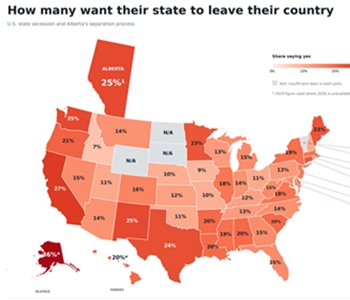
In evaluating this result it seems worth noting that, according to recent YouGov polls, two US states (Alaska and California) show greater percentages (36%, 27%) who “want their state to leave their country,” while five additional states (Washington, New Mexico, Texas, Minnesota, and Maine) show similar percentages to Alberta in Canada on October 19, 2026 (23%–25%).
Similarly, the one-quarter of participating Albertans who chose “referendum” rather than “remain”in 2026 comes nowhere near the 40.4% of Quebecers who voted for “sovereignty” in 1980, to say nothing of the 49.4% who similarly voted in 1995. (Albeit in both cases even in francophone-majority Quebec the exact referendum questions included some form of continuing “association” with Canada!)
Moreover, as Prime Minister Carney has stressed, Canada is a democracy. And a three-quarters vote is a quite decisive democratic majority of participating Albertans who have stood up boldly and unambiguously for their continuing Canadian citizenship. Like many who live in the Great Lakes region of Canada, I am suitably and happily impressed (if hardly surprised) by this strong Canadian result in Wild Rose Country.

Meanwhile, I also think the answers to the other nine complex questions included in the Alberta referendum are in some ways more interesting. In one sense, I agree with Naheed Nenshi, Alberta NDP leader, that the first nine questions do not make a lot of practical down-on-the-ground sense. At the same time, viewed more as an ideological exercise, I also think Premier Smith’s somewhat cagey referendum on 10 key current Alberta policy questions is worth some dissection.
(And as the late great Canadian political theorist C.B. Macpherson demonstrated long ago, in Democracy in Alberta : Social Credit and the Party System (first published 1953, second edition 1962) Alberta provincial politics can have its own deep fascinations.)
(2) The long count on the results and two initial mis-impressions
The unusually slow return of all the polls has made for some ongoing intrigue. (Beyond the 75%/25% split on the earlier clear enough key question 10 : Alberta ? Remain in Canada or Hold a so-called Binding Referendum on Leaving?). And in this site’s particular backyard that led to at least two mis-impressions about the ultimate results on the first nine questions.

The first was an apparent tapering off of voter participation after the initial big issue in question 10. Early on in the returns it was clear that the largest number of eligible voters answered question 10. But then there was what seemed an almost systematic and, as it were, progressive reduction in voter participation as voters moved from questions 1 to 9.
In the end there remains some slight tendency for different degrees of voter participation in certain questions on the latest calculations with the CBC data. But it is nowhere near as pronounced as it seemed at one point in the ongoing returns, and it is not systematically progressive, 1 through 9. (See more on this below.)
The second mis-impression was that the Yes side was winning on at least eight of the first nine questions — not by anything like the 75% voting for “Remain” rtather than “Referendum” on question 10, but more like 55% Yes to 45% No. And this lent at least some weight to Premier Smith’s initial urging that the people of the province had voted for “A strong Alberta in a united Canada.”
In the end here, however, voters answered Yes to questions 1 to 5, but No to questions 6 to 9. Moreover, and not accidentally perhaps, the first five questions involve potential actions by the Government of Alberta alone. But questions 6 to 9 involve “the Government of Alberta working with the governments of other willing provinces to amend the Canadian Constitution.” And close to two-thirds of eligible Alberta voters said No to all four questions involving potential constitutional amendments.
In broad terms voters said Yes to the first five of the 10 key questions, and No to the second five questions — a little less like a strong Alberta in a united Canada than it had seemed at first.
(3) Results for All 10 Questions in most to least popular order
As of 10 PM this evening the results for all 10 questions, ranked from most to least voting participants shakes out as follows :
10 : Alberta remains in Canada or holds a “binding referendum” on leaving — 75.0% Remain, 25.0% Referendum.
1 : Increased provincial control over immigration — 54.7% Yes, 45.3% No.
5 : Provide proof of citizenship for voting — 58.1% Yes, 41.9% No.
6 : Const amend for stronger provincial role in appt judges — 54.7% No, 45.3% Yes.
8 : Const amend so province can opt out of federally funded programs without losing federal funding — 57.6% No, 42.4% Yes.
3 : Immigrants must reside in Alberta for at least 12 months before qualifying for provincially-funded social support programs — 53.1% Yes, 46.9% No.
4 : Prov can charge reasonable fee to those living in Alberta with a non-permanent immigration status for use of healthcare and education systems — 52.0% Yes, 48.0% No.
9 : Const amend that prov laws have priority when fed and prov laws conflict — 55.5% No, 44.5% Yes.
7 : Const amend to abolish Senate of Canada — 52.7% No, 47.3% Yes.
2 : Only Canadian citizens, permanent residents and individuals with an Alberta-approved immigration status are eligible for such provincially-funded programs as health care and education — 52.4% Yes, 47.6% No.
(4) The view from the northwest shore of Lake Ontario
I suppose I have to confess that from the standpoint of everyday life on the northwest shore of Lake Ontario in Canada’s current most populous metropolis, all this does have a certain wild and crazy look. And if I lived in Alberta I would be voting for a prospective first Canadian Muslim premier Naheed Nenshi not Danielle Smith in the next provincial election soon enough.
At the same time, I think this October 19, 2026 Alberta referendum does suggest some impressive continuing vigor in C.B. Macpherson’s Democracy in Alberta today. And I can only wish our provincial democracy had some kind of similar vigor in Doug Ford’s Ontario — where voter turnout in the last two provincial elections was a meager 44% and 45%.
O and btw on October 19 two out of 87 Alberta ridings actually voted for a separation referendum on question 10 — Central Peace-Notley (50.4% Referendum, 49.6% Remain), and Rimbey-Rocky Mountain House-Sundre (51.1% Referendum, 48.9% Remain).
Central Peace-Notley is “a largely rural riding located in northwestern Alberta. There are no cities in the riding” which “takes its name from its central location in the Peace River Country and from Grant Notley, who represented the region in the Legislature from 1971 to 1984 while serving as leader of the Alberta New Democratic Party.” Grant Notley is also the father of Rachel Notley, NDP Premier of Alberta, 2015–2019. He died in a tragic small plane crash against a snow-covered Alberta mountain in 1984, at the age of 45.