Why deeper Canada-Europe ties have such broad public support in Canada : “EU is viewed positively by 71% of Canadians .. United States? Just 21%”
Sep 19th, 2026 | By Randall White | Category: In Brief
RANDALL WHITE. HOME AND NATIVE LAND. FERNWOOD PARK, TORONTO. FRIDAY, SEPTEMBER 18, 2026. As long ago as 1930 Harold Innis, author of The Fur Trade in Canada : An Introduction to Canadian Economic History (still the most interesting and single best — if not exactly easiest to read — book on any kind of Canadian history) began the conclusion of his local classic with :
“Fundamentally the civilization of North America is the civilization of Europe.” And the main broad “interest” of Innis’s pioneering Canadian fur-trade study of 1930 was “primarily in the effects of a vast new land area on European civilization.”
You might almost guess that somewhere along the line both PM Carney and some among his own updated new/old Ottawa officialdom have lately been reading the conclusion to Harold Innis’s first big book on the “northern North American” resource economy themselves.
And it seems reasonable enough that in the third decade of the 21st century a country of this sort would be graced by an offer to become the first “associate member” of the European Union.
(1) “Carney says Parliament will vote on EU partnership”
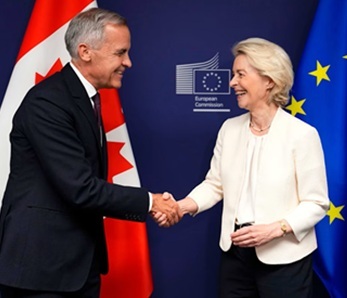
The exact nature of this “associate member”status (proposed by Ursula von der Leyen, “President of the European Commission”) inevitably remains for the moment not entirely clear.
Yet it seems likely that a Canada which became the first of the new breed (Australia and New Zealand, other EU figures have suggested, would soon follow) could help define any such status practically.
In any case we happily need not worry about such details for the moment : “Carney says Parliament will vote on EU partnership” in the soon enough fullness of time.
Meanwhile, who can deny the symbolic power already in the transatlantic air; eg, “Spanish Prime Minister Pedro Sánchez posted an image of the EU flag with a red maple leaf beside it Thursday morning.”)
(2) The long history of Canada’s interest in some new European trade deal since Pierre Trudeau
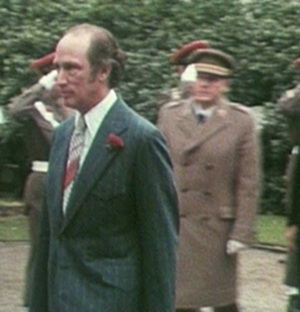
It is true enough as well that PM Carney is not doing anything new in trying to cultivate closer Canadian trade and related economic and other ties to the quite vast European economy of the later 20th and 21st centuries.
PM Pierre Trudeau made serious efforts in this broad European direction, starting half a century ago, as it became clear that Canada’s traditional hedge against too much USA USA, in the old global markets of the British empire (and commonwealth), was fading dramatically.
Here as elsewhere, however, the increasingly wild and crazy presidencies of the twice-elected Donald Trump are still trapped in the last gasps of Harold Innis’s “American imperialism … made plausible and attractive in part by the insistence that it is not imperialistic/”
And this seems to have finally galvanized various deeper real-world connections between Canada and Europe, in a way heretofore lacking.
(3) Some surviving impacts of the extended Canadian age of the old European global empires
Meanwhile, back some 96 years ago, Innis ended the first section of his Fur Trade in Canada classic in another way that seems still relevant in the new 21st century Age of Trumpian Trade War (or the American Imperial Quest for Commercial Union with Canada, as some might have said back in the late 19th and earlier 20th centuries) :
“Canada has participated in the industrial growth of the United States, becoming the gateway of that country to the markets of the British Empire. She has continued, however, chiefly as a producer of staples for the industrial centres of the United States even more than of Great Britain, making her own contribution to the Industrial Revolution of North America and Europe and being in turn tremendously influenced ….”
At the same time, Canada’s longer experience with the more imperialistic European global imperialism of the British (and French) Empire has left it with more traditional attachments to Europe and its institutions than have survived in the (in some ways) more revolutionary USA.
(And the extended Canadian age of the old European global empires has arguably also left Canada with at least somewhat slightly warmer attachments to its relatively larger share of the new global migrants from Asia and Africa than the USA — while Western Europe itself now has its own large numbers of the latest gobal migrations.)
(4) European Union in 2020s not at all like USA in 2020s (especially under crazyDonald Trump)

It finally is worth stressing — as PM Carney quietly alluded to in his initial response to the initial Trumpian/Old School Commercial Union reaction to Canada as an EU “associate member” — that the European Union in the 2020s is not a political organization at all like the United States of America in the 2020s.
(Especially under the second and more intensely wild and crazy [and clearly to most historians ”historically worst”] presidency of the pushy spoiled brat from a corrupt and rich enough Queen’s New York real estate family, who, it seems most accurately reported, stood at the bottom of his graduating Eastern Seaboard elite university class.)
Consider, eg, that the talk about Canada’s becoming the first “associate member” of the EU today has come from Ursula von der Leyen, “President of the European Commission”. She is in fact not the only “President of the European Union”. There are three of them — President of the European Parliament, President of the European Commission, and President of the European Council. (See accompanying Wikipedia “Organigram” as just the simplest of starting points!)

This kind of diverse political organization could be something that any Canadian federal government in Ottawa, accustomed to working so hard to govern its own complex country (that PM Mackenzie King long ago complained has “too much geography”) can rather easily understand and work with.
Knee-jerk complaints about Ms Von der Leyens’s “bureaucrats in Brussels” notwithstanding, the EU is not an organization that can dominate let alone subjugate such strong full member states as France, Germany, Italy, Spain, and all that deep and still bubbling modern European history.
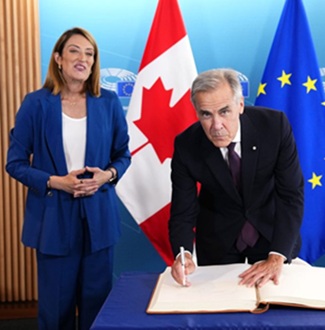
(And it is “Roberta Metsola, President of the European Parliament” who “has suggested that Australia and New Zealand could follow Canada in becoming associate members of the EU.”)
Even “associate member” of such an organization could prove to be an effective, interesting, progressive, and useful status, in some rising and different world order from the one Donald Trump has been working so hard to destroy, for reasons that have never made much real-world “common sense”.
(And very finally again at last note a recent Abacus Data poll which found that the “EU is viewed positively by 71% of Canadians. The United States? Just 21%. That 50-point gap helps explain why deeper Canada-Europe ties now have such broad public support.”)