Midsummer night’s dream — on John Lahr’s review of David Margolick ‘s book on the late great Sid Caesar (and his “comic academy” of early TV writers)

Posted: July 17th, 2026 | No Comments »
Michael Seward, “Perfect! We’ll be there!”. 2026.

RANDALL WHITE, NORTH AMERICAN NOTEBOOK, TORONTO. FRIDAY, JULY 17, 2/026. One of my approaches to coping with the extreme summer heat and wildfire smoke we are currently assailed by in Toronto (along with many adjacent places in both Canada and the US) has been to sit in my most air-conditioned room, and read the latest print issue of the London Review of Books to arrive in the old-school mail.

I have been especially struck by John Lahr’s 3,650-word piece on David Margolick ‘s When Caesar Was King: How Sid Caesar Reinvented American Comedy.

John Lahr is an eminent if now somewhat retired theatre and movie critic (“currently a chief theater critic emeritus of The New Yorker”). He is also the son of Bert Lahr who played the Cowardly Lion in the 1939 Wizard of Oz movie. His review of David Margolick ‘s new Sid Caesar book (rated 4.4 out of 5 on the Amazon site) is fun to read and well worth any deep reader’s time. And it comes to more than a few heavyweight and no doubt apt judgments.

Mr. Lahr, however, does have his (man-in-his-80s) reservations about both Sid Caesar and David Margolick’s book. (If it is true eg that Sid Caesar Reinvented American Comedy, John Lahr complains, “then gallstones are jewellery.”)

I

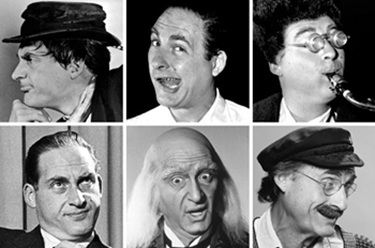
A half dozen Sid Caesar characters from his great TV age in the 1950s.

My brother and I — both pre-teens at the time — were enthusiastic TV fans of “the hour-long Caesar’s Hour (1954-57).” We missed the earlier Admiral Broadway Revue (1949) and the 90-minute episodes of Your Show of Shows (1950-54), almost certainly because our family did not have a TV set until the mid 1950s.

I have only a few sketchy recollections of particular Sid Caesar TV skits and characters from 1954 to 1957. (I am also an old man in his 80s.) But I do happily remember how much my brother and I enjoyed watching Caesar’s Hour. (I don’t have memories of my parents watching almost any TV at that point : they had too many better things to do with their time. Our modest TV set was always sequestered away in some small extra bedroom, or in the basement.)

From left to right — Mel Brooks, Woody Allen, Mel Tolkin, and Sid Caesar hard at work in the 1950s.

John Lahr ultimately seems to argue that if anyone ”reinvented American comedy” for the new age of TV it was the writers (“the star alumni of Caesar’s comic academy”), who largely gave Sid Caesar his clever lines and comic gags — eg (in alphabetical order by surname) : Woody Allen, Mel Brooks, Larry Gelbart, Lucille Kalen, Howard Morris, Carl Reiner, Neil Simon, Joseph Stein, Michael Stewart, and Mel Tolkin (the last of whom was “head writer on all Caesar’s shows in the 1950s”).

It is true as well that after his early TV success in the 1950s the Sid Caesar who had his first show when he was only 27 years old struggled through the 1960s and 1970s — and beyond. Almost from the start, it seems, he abused alcohol and drugs. He was not easy to get along with. His original female TV partner Imogene Coca was succeeded by Nanette Fabray by the time my brother and I started watching Caesar’s Hour. Ms Coca later wrote to Lucille Kalen : “We all had success – we all made more money than we’d ever made – did it have to be that agonising?”

II

“Imogene Coca and Caesar in Your Show of Shows (1952).”

To me John Lahr does not quite capture whatever it was that made my brother and I such keen Sid Caesar fans back in the day. I see more of that in a few tributes from his former writers after his death :

“He was the ultimate, he was the very best sketch artist and comedian that ever existed” (Carl Reiner) ; “Sid Caesar was a giant, maybe the best comedian who ever practiced the trade. And I was privileged to be one of his writers and one of his friends” (Mel Brooks) ; “He was one of the truly great comedians of my time” (Woody Allen).

I do nonetheless especially like the very beginning of John Lahr’s piece in the 25 June 2026 London Review of Books : “Those who were born in the US in the early 1940s, as I was, came of age in the most buoyant period of the 20th century. In the years between 1945 and 1960, personal income almost tripled. Philip Roth called it the greatest moment of ‘collective inebriation in American history’. After the Great Depression and two world wars, the middle classes were beginning to live America’s dream of prosperity; the less fortunate didn’t yet seem to be spoiling the charm of abundance.” (And something somewhat similar might be said about Canada next door, where I was born myself in 1945.)

Nanette Fabray and Sid Caesar in the later 1950s.

It’s the last sentences of John Lahr’s LRB piece that especially don’t ring true for me, or I don’t quite understand : “Caesar smiled with cold teeth at the accomplishments of the graduates from his comic academy. To Brooks … now responsible for the Broadway mega-hit The Producers, he said: ‘So, you went from me to Hitler.’ To Woody Allen, he offered: ‘Funny that I’m going to be a footnote in your life story.’ Margolick’s biography excavates the story of Caesar’s forgotten heroics, but Caesar himself, in all his delirium and delight, remains a ghostly remnant.”

Mr Lahr is probably apt enough when he suggests : “Although he made a couple of hapless attempts at resuscitating his TV career, by 1960, at the age of 38, his comic ride was over.”

Yet as actually becomes clearer on Wikipedia, whatever else Sid Caesar did keep working after 1960, in less glamourous and big-league but still intriguing ways.

III

Just a few Wikipediac examples : “Playing eight parts with 32 costume changes, he was nominated in 1963 for a Tony Award for Best Leading Actor in a Musical” ; “In 1977, after blacking out during a stage performance of Neil Simon’s The Last of the Red Hot Lovers in Regina, Saskatchewan, Caesar gave up alcohol “cold turkey”” ; “In 1983, Caesar hosted an episode of Saturday Night Live, where he received a standing ovation” ; “In 1997, he made a guest appearance in Vegas Vacation and, the following year, in The Wonderful Ice Cream Suit based on a Ray Bradbury novel.”

Sid Caesar and Florence Levy — his “much-adored wife of nearly seven decades”, when they first met at the Avon Lodge in the Catskills in 1942.

It is also true that in the summer of 1943 Sid Caesar, born in 1922 in Yonkers, New York (and still in the US Coast Guard in 1943), married Florence Levy, who he’d met the year before in the Catskill Mountains (where Sid had earlier played saxophone in a dance band). They had three children (and eventually two grandchildren). They stayed married until Florence’s death in 2010. Sid Caesar himself “died on February 12, 2014 at his home in Beverly Hills, California, at the age of 91, after a short illness”.

None (or almost none) of this Wikipedia data on Sid Caesar after 1960 is altogether touched on in John Lahr’s review of David Margolick ‘s When Caesar Was King: How Sid Caesar Reinvented American Comedy.

And this kind of thing, I think, does connect more exactly with my brother and I’s mid to late 1950s fascination with Sid Caesar on TV. At the same time, there is another piece of Mr Lahr’s piece that I do seriously and quite strongly admire, especially considering my more recent reporting on the life of Alan Greenspan.

IV

Sid Caesar (second from left) in the movie It’s a Mad, Mad, Mad, Mad World (1963).

From Wikipedia you can discover that Sid Caesar (like Alan Greenspan) started his early adult life imagining he was going to be a professional saxophone player : “he briefly played with Shep Fields, Claude Thornhill, Charlie Spivak, Art Mooney and Benny Goodman. Later in his career, he performed “Sing, Sing, Sing” with Goodman for a TV show.”

In fact a short comedy routine Caesar casually worked up in connection with his saxophone career soon enough lauchned him on his comedy career. But John Lahr almost seems to suggest that Sid Caesar would have been better off if he’d just stuck with his saxophone :

“The saxophone marks the moment in Caesar’s life when he was properly born. ‘What the music did for me was not only train me as a musician, but also allow me to think creatively. You could ad lib and be very creative as long as you stayed within the chord structure,’ he wrote. ‘Comedy is music. It has a rhythm and a melody. It elicits passion, joy and melancholy. And if you listen to it, you can hear a beat.’”

Sid Caesar in this later years.

Mr. Lahr goes on : “If you want to get the feel of the real Sid Caesar, watch him on YouTube playing the saxophone with Benny Goodman on the clarinet and Gene Krupa providing the backbeat. Caesar is briefly at home in himself: alive, swift, going with the big band’s flow. He’s beyond sorrow and words. He’s making a beautiful noise in the world. ‘Comedy and music have much in common and I often sought to combine the two,’ he wrote.” (And if you do watch the YouTube clip here, note that on my calculations Sid Caesar does not appear on his saxophone until c. 6 minutes and 20 seconds into the recording.)

I agree with this John Lahr saxophone insight — and think it’s altogether brilliant.

But what I get from the YouTube clip of Sid Caesar’s later ‘Sing, Sing, Sing’ performance with Goodman and Krupa (and others in the backing big band) is, I think, pretty much the same as what my brother and I got from watching Sid Caesar on TV in the 1950s, when we too were growing up, during another of Philip Roth’s “greatest moment[s] of ‘collective inebriation’” some 30 to 50 miles north, across the lake from New York State.

PM Carney’s Independent Advisory Board for Senate Appointments will be different from PM Justin Trudeau’s — and that probably does make sense today

Posted: July 11th, 2026 | No Comments »
Michael Seward, Untitled. 2026.

RANDALL WHITE. FERNWOOD PARK, TORONTO. SATURDAY, July 11, 2026. The already hazy early summer probably is a good time for Prime Minister Carney (acting as principal advisor to the Governor General, in strictest 1867 written constitutional terms) to make his first four appointments to the still unreformed Senate of Canada.

Appointees include two new representatives for Quebec — “now-former Conservative MP Richard Martel and longtime Liberal Tom Pitfield, the PMO’s principal secretary.” To round out this first batch of new PM-Carney-appointed senators, add “Geeta Tucker, for Manitoba” and for New Brunswick, Dr. Rodney Ouellette.

Former Conservative MP Richard Martel.

Some observers have seen these appointments (and the apparent process or lack thereof behind them) as “most cynical” or at least “disappointing.” I may be too much of a cynic about the various real worlds of Canadian politics myself to altogether agree. But I get the point.

At the same time, the Prime Minister’s statement announcing his first four Senate appointments has also announced that : “With five more Senate vacancies anticipated before the end of 2026, a new Independent Advisory Board for Senate Appointments will be established in the coming days. Guided by constitutional requirements and merit-based criteria, the Board will identify highly qualified candidates with diverse experience and perspectives, and make recommendations to the Prime Minister. Canadians are invited to apply to serve in the Senate through an application process that will open in the coming weeks.”

Read the rest of this page »

On saxophone players who become public servants (stand up Alan Greenspan) — and others in Ontairiairio who don’t!

Posted: July 3rd, 2026 | No Comments »
Michael Seward, Untitled. 2026.

RANDALL WHITE, TORONTO. FRIDAY, JULY 3, 2026. Here’s to a belated Happy Canada Day 2026 this past Wednesday, July 1 — the 159th anniversary of the Canadian confederation of 1867 (which gave the old Canada or New France, almost certainly named after an Iroquoian word more or less like Kanata, its most recent modern lease on life).

Tomorrow on July 4 of course there will be various celebrations of the 250th anniversary of the US Declaration of Independence in 1776 south of our Canadian border. For many Canadians, however, July 4, 2026 will mean most as the date of Canada’s World Cup match against Morocco at Reliant Stadium in Houston, Texas. (See “Cheer for the boys’: Fans flying to Houston for Canada’s historic World Cup match.”)

“Canada scored a stoppage-time winner against South Africa in their round-of-32 match to set off wild celebrations [AFP].”

Whatever happens in World Cup 2026 Canadians (and others) who live in Toronto, capital city of Canada’s most populous province of Ontario, can also spend either or both tonight (July 3) and/or tomorrow night at The Rex Hotel Jazz and Blues Bar, on the north side of Queen Street just west of University Avenue. The July 3 and 4 entertainment here is the Barry Elmes Quintet — Barry Elmes, drums ; Brian O’Kane, trumpet ; Chris Gale, tenor saxophone ; Lorne Lofsky, guitar ; Pat Collins, acoustic bass.

Other commitments on both July 3 and 4 mean that I will not be able to drop by The Rex (at the end of a long if often agreeable streetcar ride for me).I regret this a lot because Chris Gale is my current favourite Toronto saxophone player (or just favorite sax player generally). And I do not hear him play at all as often as I’d like.

Read the rest of this page »

Can ordinary people take advantage of capitalist class by playing their game??

Posted: June 27th, 2026 | No Comments »

Michael Seward, No title, 2026.

RANDALL WHITE, NORTH AMERICAN NOTEBOOK, TORONTO. FRIDAY, JUNE 26,026. One so far surviving feature of Democracy in America even under Donald Trump II is frequent elections.

On the way to the big November 3 federal midterms, this past Tuesday, June 23 offered primary elections (within political parties) in four states : Maryland, South Carolina, Utah, and (especially) New York.

These elections (again especially in New York) have apparently boosted the left in what CNN analyst Ron Brownstein has called the “unusual, even unprecedented” battle “between left and center” in the Democratic Party, that has marked the journey to the 2026 midterms.

As the New York Times ultimately reported on key June 23 Democratic primary races in the Empire State of New York : “Mamdani Allies Sweep House Primaries in Big Night for Left-Wing Democrats.”

(1) Robert Reich in Berkeley, California and Simon Kuestenmacher in Melbourne, Australia

Meanwhile, without yet knowing this result, far away on the other side of the country Robert Reich in Berkeley, California had posted on his favourite social media just after 5 AM on the morning of June 23, 2026 a piece called “Class Warriors, Class Worriers, and Class Wimps.”

In keeping with the spirit many saw in what did finally happen this past Tuesday (yet again especially in New York), Mr. Reich’s clearly “left” as opposed to “center” message urged : “It’s time for Democrats to take on the class war that’s being waged by the nation’s oligarchy against most Americans by becoming class warriors themselves.”

As Robert Reich spelled out in his buildup to this class warriors proposition : “Workers’ share of the nation’s income has now dropped to the lowest it’s been since records began in 1947, while profits’ share is the highest since 1950 (showing up in a rip-roaring stock market) … This is morally wrong. ‘Income from capital risks replacing income from labor,’ Pope Leo wrote in Magnifica Humanitas, his recent encyclical letter.”

As the German geographer and demographer currently residing in in Melbourne, Australia, Simon Kuestenmacher, somewhat similarly posted on X on June 25, 2026 : “The top 1% in the US now hold as much wealth as the entire bottom 90% of Americans combined (32% each) … Widespread anger in an economy that is very unequal isn’t surprising.”

Read the rest of this page »

Three cheers for new Obama Presidential Center on Chicago’s South Side (and for Barack Obama’s high-minded words missing from White House today)

Posted: June 19th, 2026 | No Comments »
Michael Seward, No title, 2026.

RANDALL WHITE, NORTH AMERICAN NOTEBOOK, TORONTO. THURSDAY, JUNE 18, 2026. Today marks the grand opening of the Obama Presidential Center in Chicago. In the middle of so much so wrong about the USA today, the event reminds us that some sides of the American past, present, and future still look “close enough for jazz.”

Every US President since Herbert Hoover (1929–1933) has at the end of their time in office acquired a “Presidential Library and Museum,” ultimately operated “under the federal system managed by the National Archives and Records Administration (NARA),” and “spread across the country, usually in a location tied to the president’s home state or personal history.”

The new Obama Presidential Center — 19.3 acres on the South Side in Chicago. Courtesy Angie McMonigal.

I have only visited one of these now 14 (and soon enough to be 16) presidential libraries myself — the Harry S. Truman Library & Museum in Independence, Missouri. I was in the adjacent Kansas City, MO contemplating the urban geography that initially bred the world’s greatest saxophonist, Charles Parker Jr. I visited the nearby Truman library to occupy a spare afternoon without prior intention. But I found my visit interesting, and even at a few points moving.

In keeping with Barack Obama’s unique contribution to US politics and even American life more broadly, the new Obama Presidential Center tries to do something more and at least somewhat different than its predecessors. The Truman library, eg, “was established to preserve the papers, books, and other historical materials relating to former President Harry S. Truman and to make them available to the people in a place suitable for exhibit and research.”

Michelle and Barack Obama at opening of the Obama Presidential Center on June 18, 2026.

The Truman library itself is more than a strictly academic research operation, catering to political historians and other professional researchers. Many of its exhibits have a popular edge, and the place is “ranked among the top tourism destinations in the Kansas City region.”

The new Obama Center, however, is also trying to attract eg the struggling local youth of South Side Chicago where it is located. It offers a presidential museum in a tall building. But it also has a local branch of the Chicago public library for ordinary young readers, and some 19 acres of parkland dotted with recreational facilities for younger local visitors just looking for a place to hang out (including a regulation NBA-size basketball court).

Read the rest of this page »

“In Ontario Donald Trump is pronounced Doug Ford” .. & Premier Ford’s current 21% approval even more appalling if he stays in office until April 2030

Posted: June 13th, 2026 | No Comments »
Michael Seward, No title. 2026

RANDALL WHITE, NORTH AMERICAN NOTEBOOK, TORONTO. FRIDAY, JUNE 12, 2026. It seems likely enough that Doug Ford, Premier of Canada’ most populous province of Ontario , is not too popular with US President Donald Trump these days.

See eg : “U.S. Chamber of Commerce event with Doug Ford cancelled after White House complaints, sources say” (June 9, 2026).

President Trump has also on occasion had a few kinder words to say about Ontario’s premier : Eg “Trump says he respects ‘very strong man’ Ford after Ontario premier suspends electricity surcharge” (from March 11, 2025 — more than a year ago now!).

Doug Ford (left!) with Wolf Blizter on CNN, June 2026.

Other US politicians and political observers have lately expressed more positive views on Doug Ford. CNN anchor Wolf Blitzer, who “grew up in Western New York on the border with Ontario” and is happy to confess “I love Canada,” had Premier Ford on his TV show this week.

And then Pennsylvania’s (Democratic) Governor Josh Shapiro visited Premier Ford at Queen’s Park in Toronto the day before yesterday. While in town Governor Shapiro slammed President Trump’s latest 51st state Canadian imaginings as “Reckless and disrespectful.”

More than a few actual Ontario residents have lately been expressing less optimistic views of their premier. On June 11, 2026 John Smith “(son of Harry Leslie Smith)” posted./tweeted on Twiitter/X : “In Ontario Donald Trump is pronounced Doug Ford.”

Read the rest of this page »

Separatism not looked on with great interest by close to three-quarters of Alberta’s free and democratic Canadians

Posted: June 6th, 2026 | No Comments »
Michael Seward, No title. 2026.

RANDALL WHITE, TORONTO. FRIDAY, JUNE 5, 2026. Two recent polls suggest this coming fall’s Alberta separatist referendum is not at all likely to lead to any actual separation from the rest of Canada.

Ipsos, in the field May 28–June 1, 2026, found “Limited and Declining Support for Separation in Alberta … Only 18% say they would vote for separation if a binding referendum is held; This is a decline of 10-points from 28% support in January 2026 … More than seven-in-ten (72%) Albertans currently support the referendum option to stay in Canada … Ten percent of Albertans are undecided, will not vote or prefer not to answer..”

Leger, similarly last in the field on June 1, found “73% of Albertans say Alberta should remain part of Canada, while 15% say it should become an independent country.”

Polling Canada’s recent map of forthcoming “independence” vote in Canada’s fourth most populous and oil-rich province of Alberta : “This might end up being the most one-sided independence referendum to ever exist.”l

There are some subtleties in both polls. Ipsos found that : “Currently, only two-in-ten (19%) Albertans say they would vote for the option to hold a future binding referendum on separation,” as in the exact question to be asked in the (as it were preliminary or merely exploratory ) fall referendum Premier Smith has announced.

Leger found that while only 15% would support an independent Alberta, an additional 6% would support “joining the United States.”

In both Ipsos and Leger polls, however, more than 70% of Albertans would support remaining in Canada. And this compares favourably enough with the 60% of Quebecers who voted to stay in Canada in the 1980 Quebec referendum (on ”sovereignty association”).

Ipsos also reports that : “By region, support for moving ahead with a binding separation referendum is lowest in Calgary (14%), slightly higher in Edmonton (18%) and highest in the rest of Alberta (27%).”

Read the rest of this page »

Central Canada greets almost summer 2026 — tech recession, GTA synagogue shootings, financial system good shape, First Nations disrespected in Thunder Bay

Posted: May 29th, 2026 | No Comments »

Michael Seward, Untitled. 2026.

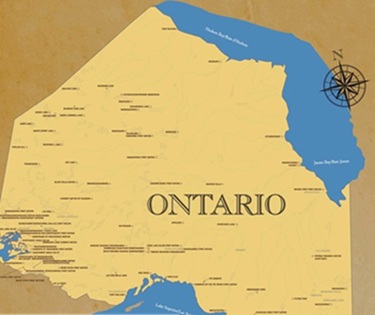
RANDALL WHITE, TORONTO. FRIDAY, MAY 29, 2026. In some ways calling Canada’s most populous province of Ontario “Central Canada” is a misnomer.

The geographic dead centre of the country is in Manitoba, just next door west of Ontario. (And the current Premier of Manitoba, Wab Kinew, was born in Kenora, Ontario — the real-world metropolis for which is Winnipeg, Manitoba not Anyplace, Ontario.)

Nonetheless there is a sense in which Ontario — from the Ottawa River to the Lake of the Woods and the Great Lakes to Hudson Bay — does at least see itself as a kind of cultural central Canada. It is, to start with, the most populous province (with some 38.9% of the Canada-wide total population, as of the First Quarter of 2026).

Manitoba (left) and Ontario (right) provincial flags — both artifacts of an earlier Canadian colonial era that ought to be updated in the mid 21st century.

With the second-largest provincial geography (after Quebec) Ontario is anchored by Canada’s current largest metropolis at one southern end, and at the other northern end by the only somewhat icy waters of Hudson Bay and assorted inland lake-and-river systems, that still almost echo the far northern universe four centuries ago.

And finally at least to many Ontario ears, it never seems quite right to say we live in Eastern Canada. Some US friends, eg, say we’re North American Midwest. And on and on … into at least central if not quite Central Canada. (And note how the Ontario and Manitoba flags do look similar.)

Read the rest of this page »

Back to Joe Clark’s “Community of Communities” vs Pierre Trudeau’s “Who will speak for Canada?” in current Canadian separatism debate? … Why not?

Posted: May 22nd, 2026 | No Comments »
Michael Seward, No title. 2026.

RANDALL WHITE, TORONTO. FRIDAY, MAY 22, 2026. Here, humbly offered, is yet another quick note on the new gathering storm over Canadian separatism.

As in : “Leaders across the political spectrum are responding today to news that Alberta’s fall referendum will now decide whether Albertans want a vote on separatism this coming October.”

I’m not an altogether faithful fan of the CBC At Issue panel on Thursday nights. But if I notice something interesting in the endless news channel flipping that so often annoys my TV watching partner, I often do stop by.

Last night I was lucky enough to catch a highly civilized but admirably clear exchange between Chantal Hebert and Andrew Coyne, over what the big Canadian separatism debate going on right now really means. And it somehow suddenly did seem to make a few things clearer to me, in a historical sense I hadn’t quite grasped before.

Chantal Hebert and Andrew Coyne, back at the time of the 2015 federal election, which brought Pierre Trudeau’s eldest son Justin into office as yet another Liberal Prime Minister of Canada.

Ms Hebert began by suggesting that Premier Smith in Alberta (if I understand the point correctly) is now ultimately urging a view similar to that of another Conservative leader from Alberta, Joe Clark, back in ancient days. Clark had declared Canada a “community of communities,” in response to Premier Robert Bourassa’s quest for a “distinct society” in Quebec.

I had the (perhaps not altogether correct?) impression as well that Chantal Hebert was happy enough with this kind of decentralist vision of the Canadian confederation of 1867 today — within which all of Quebec, Alberta, other provinces (BC, Ontario, Nova Scotia, and so forth) and a strong (enough) federal government can somehow be accommodated.

Read the rest of this page »

Alberta separatism today may be inspired by Quebec separatism, but it is not really the same at all (and does not want to be?)

Posted: May 19th, 2026 | No Comments »
Michael Seward, Untitled. 2026.

COUNTERWEIGHTS EDITORS. GANATSEKWYAGON, ON. TUESDAY, MAY 19, 2026. Alberta is much in the Canadian news lately. One point of departure is : “New deadline for pipeline deal. Lower industrial carbon price. Carney government, Alberta strike deal to fast-track building new pipeline by 2027” (Tonda MacCharles). Or : “Carney, Smith sign carbon price deal, suggest fall 2027 pipeline approval” (The Canadian Press).

Arguably enough, for both provincial and federal governments pipeline action of this sort is at least partly addressed to whatever real forces lie behind the current Alberta separatist movement, vaguely modeled on the more ancient example in la belle province.

At the same time, this particular objective may have suddenly become redundant. Alberta courts, some now argue, have finally cut Alberta separatism off at the knees. See eg : “For Danielle Smith and Alberta separatists, no clear path left for referendum after court loss … Pressure mounting for premier to commit to the vote her UCP base wants, but First Nations have blocked” (Jason Markusoff, CBC News).

For some excellent related commentary try : “ How two Alberta judges shot separatist delusions to death … And, not for nothing, they probably just wrecked Quebec separatism, too” (Clarke Ries, in The Line, an Alberta-based “independent Canadian media outlet focused on politics, policy, and the forces shaping the country”).

Agreeing and disagreeing with Clarke Ries on Alberta separatism

An Alberta separatist rally at the Alberta Legislature on May 3 [2025]. Photo by Shaughn Butts /Postmedia.” Note crest or coat of arms or shield on Alberta provincial flag these separatists fly proudly bears striking resemblance to crests or coats of arms or shields on provincial flags of Manitoba and Ontario.

We counterweights editors here happily agree with the admirable Clarke Ries that current Alberta separatism is a “movement born out of petty resentment over the fawning treatment accorded to post-referendum Quebec.” (Well maybe not entirely “petty” or “fawning” but …)

The movement has now fallen to its knees, it is said, as a result of two court cases whose bottom line is that an Alberta-wide independence referendum on (and even the whole project of) Alberta separatism is constrained by Canadian First Nations’ constitutional “right to be consulted” about (if not to altogether “veto”) future plans for Canada and its provinces.

Our disagreement here focuses on Clark Ries’s already somewhat qualified suggestion that Alberta court cases on the more recent struggles of separatism in Alberta may have “just wrecked Quebec separatism, too.”

Read the rest of this page »