On saxophone players who become public servants (stand up Alan Greenspan) — and others in Ontairiairio who don’t!
Jul 3rd, 2026 | By Randall White | Category: In Brief
RANDALL WHITE, TORONTO. FRIDAY, JULY 3, 2026. Here’s to a belated Happy Canada Day 2026 this past Wednesday, July 1 — the 159th anniversary of the Canadian confederation of 1867 (which gave the old Canada or New France, almost certainly named after an Iroquoian word more or less like Kanata, its most recent modern lease on life).
Tomorrow on July 4 of course there will be various celebrations of the 250th anniversary of the US Declaration of Independence in 1776 south of our Canadian border. For many Canadians, however, July 4, 2026 will mean most as the date of Canada’s World Cup match against Morocco at Reliant Stadium in Houston, Texas. (See “Cheer for the boys’: Fans flying to Houston for Canada’s historic World Cup match.”)

Whatever happens in World Cup 2026 Canadians (and others) who live in Toronto, capital city of Canada’s most populous province of Ontario, can also spend either or both tonight (July 3) and/or tomorrow night at The Rex Hotel Jazz and Blues Bar, on the north side of Queen Street just west of University Avenue. The July 3 and 4 entertainment here is the Barry Elmes Quintet — Barry Elmes, drums ; Brian O’Kane, trumpet ; Chris Gale, tenor saxophone ; Lorne Lofsky, guitar ; Pat Collins, acoustic bass.
Other commitments on both July 3 and 4 mean that I will not be able to drop by The Rex (at the end of a long if often agreeable streetcar ride for me).I regret this a lot because Chris Gale is my current favourite Toronto saxophone player (or just favorite sax player generally). And I do not hear him play at all as often as I’d like.

As evidence that opinions about saxophone players can have more weight in the broader North American society than some might imagine, I note the recent sad passing of the 100-year-old former US Federal Reserve Chairman Alan Greenspan — and Kofi Adjepong-Boateng’s related recent article, “Alan Greenspan, 1926–2026: The Reedman Who Conducted the Economy … He became the most powerful central banker on earth. He never stopped wishing he could have played like Stan Getz.”
This heading may be somewhat too extreme or exaggerated. For a subtler version of Mr. Adjepong-Boateng’s view of the early Alan Greenspan, tenor sax player, see this slightly more elaborate summary: “Born in Washington Heights to a musical mother, he took up the clarinet at George Washington High School and, by his own account, spent about a year playing alongside Getz” (in the saxophne sections of old-school dance bands).
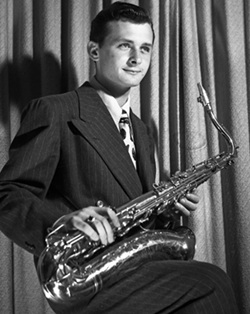
Some would think playing in the same bands as the likes of Stan Gretz an achievement in its own right. Yet (carrying on with the exact Adjepong-Boateng words) this just finally showed the young Greenspan that he was a “good amateur” musician “but only an average professional.” And the young and old Greenspan “knew what sealed” this judgment: “the sound in the next chair. As he told CBS, the young Getz ‘pretty much determined that I was going to become an economist.’”
Robert Reich in Berkeley, California might add that this is just another reason for those who do not think too highly of Stan Getz to further doubt the ultimate Getz saxophone achievement. Alan Greenspan on this view would have been just another talented but not brilliant saxophone player — harmless to the general public. Alan Greenspan the economist in real life finally proved disastrous, as the eminent Mr Reich probably wisely enough urged not too long ago.
Bringing the world closer to my own particular non-saxophone-playing experience, I note a recent press report on how “Ontario’s civil servants less confident in leadership: survey … Views sour after return-to-office mandate.”

I don’t put too much confidence in this survey. It had “a 63 per cent response rate, representing more than 43,000 employees.” This suggests a current Ontario Public Service with about 68,250 employees. Based on my experience in this organization long long ago, for one thing the more than 25,000 OPS employees who did not respond to the 2026 survey are most likely among the more influential in deciding how the OPS actually works from day to day.
Finally, for a second thing, the OPS today has as many as 22,000 fewer employees than it had when I resigned from the service more than four decades ago. And it is not at all clear to me that life in Ontario is somehow much better because there are now so many fewer provincial public servants than there were once, long ago. I do think my own personal life is better — and has been for many years. But that is something quite different again!