Midsummer night’s dream — on John Lahr’s review of David Margolick ‘s book on the late great Sid Caesar (and his “comic academy” of early TV writers)
Jul 17th, 2026 | By Randall White | Category: In Brief
RANDALL WHITE, NORTH AMERICAN NOTEBOOK, TORONTO. FRIDAY, JULY 17, 2/026. One of my approaches to coping with the extreme summer heat and wildfire smoke we are currently assailed by in Toronto (along with many adjacent places in both Canada and the US) has been to sit in my most air-conditioned room, and read the latest print issue of the London Review of Books to arrive in the old-school mail.
I have been especially struck by John Lahr’s 3,650-word piece on David Margolick ‘s When Caesar Was King: How Sid Caesar Reinvented American Comedy.
John Lahr is an eminent if now somewhat retired theatre and movie critic (“currently a chief theater critic emeritus of The New Yorker”). He is also the son of Bert Lahr who played the Cowardly Lion in the 1939 Wizard of Oz movie. His review of David Margolick ‘s new Sid Caesar book (rated 4.4 out of 5 on the Amazon site) is fun to read and well worth any deep reader’s time. And it comes to more than a few heavyweight and no doubt apt judgments.
Mr. Lahr, however, does have his (man-in-his-80s) reservations about both Sid Caesar and David Margolick’s book. (If it is true eg that Sid Caesar Reinvented American Comedy, John Lahr complains, “then gallstones are jewellery.”)
I
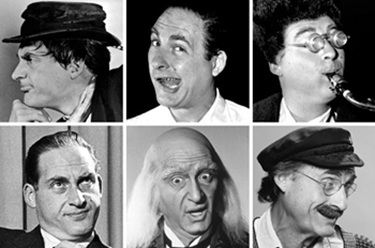
My brother and I — both pre-teens at the time — were enthusiastic TV fans of “the hour-long Caesar’s Hour (1954-57).” We missed the earlier Admiral Broadway Revue (1949) and the 90-minute episodes of Your Show of Shows (1950-54), almost certainly because our family did not have a TV set until the mid 1950s.
I have only a few sketchy recollections of particular Sid Caesar TV skits and characters from 1954 to 1957. (I am also an old man in his 80s.) But I do happily remember how much my brother and I enjoyed watching Caesar’s Hour. (I don’t have memories of my parents watching almost any TV at that point : they had too many better things to do with their time. Our modest TV set was always sequestered away in some small extra bedroom, or in the basement.)
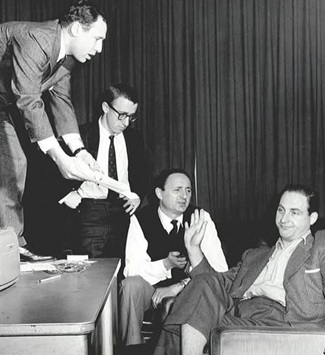
John Lahr ultimately seems to argue that if anyone ”reinvented American comedy” for the new age of TV it was the writers (“the star alumni of Caesar’s comic academy”), who largely gave Sid Caesar his clever lines and comic gags — eg (in alphabetical order by surname) : Woody Allen, Mel Brooks, Larry Gelbart, Lucille Kalen, Howard Morris, Carl Reiner, Neil Simon, Joseph Stein, Michael Stewart, and Mel Tolkin (the last of whom was “head writer on all Caesar’s shows in the 1950s”).
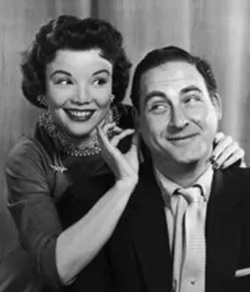
It is true as well that after his early TV success in the 1950s the Sid Caesar who had his first show when he was only 27 years old struggled through the 1960s and 1970s — and beyond. Almost from the start, it seems, he abused alcohol and drugs. He was not easy to get along with. His original female TV partner Imogene Coca was succeeded by Nanette Fabray by the time my brother and I started watching Caesar’s Hour. Ms Coca later wrote to Lucille Kalen : “We all had success – we all made more money than we’d ever made – did it have to be that agonising?”
II

To me John Lahr does not quite capture whatever it was that made my brother and I such keen Sid Caesar fans back in the day. I see more of that in a few tributes from his former writers after his death :
“He was the ultimate, he was the very best sketch artist and comedian that ever existed” (Carl Reiner) ; “Sid Caesar was a giant, maybe the best comedian who ever practiced the trade. And I was privileged to be one of his writers and one of his friends” (Mel Brooks) ; “He was one of the truly great comedians of my time” (Woody Allen).
I do nonetheless especially like the very beginning of John Lahr’s piece in the 25 June 2026 London Review of Books : “Those who were born in the US in the early 1940s, as I was, came of age in the most buoyant period of the 20th century. In the years between 1945 and 1960, personal income almost tripled. Philip Roth called it the greatest moment of ‘collective inebriation in American history’. After the Great Depression and two world wars, the middle classes were beginning to live America’s dream of prosperity; the less fortunate didn’t yet seem to be spoiling the charm of abundance.” (And something somewhat similar might be said about Canada next door, where I was born myself in 1945.)
It’s the last sentences of John Lahr’s LRB piece that especially don’t ring true for me, or I don’t quite understand : “Caesar smiled with cold teeth at the accomplishments of the graduates from his comic academy. To Brooks … now responsible for the Broadway mega-hit The Producers, he said: ‘So, you went from me to Hitler.’ To Woody Allen, he offered: ‘Funny that I’m going to be a footnote in your life story.’ Margolick’s biography excavates the story of Caesar’s forgotten heroics, but Caesar himself, in all his delirium and delight, remains a ghostly remnant.”
Mr Lahr is probably apt enough when he suggests : “Although he made a couple of hapless attempts at resuscitating his TV career, by 1960, at the age of 38, his comic ride was over.”
Yet as actually becomes clearer on Wikipedia, whatever else Sid Caesar did keep working after 1960, in less glamourous and big-league but still intriguing ways.
III
Just a few Wikipediac examples : “Playing eight parts with 32 costume changes, he was nominated in 1963 for a Tony Award for Best Leading Actor in a Musical” ; “In 1977, after blacking out during a stage performance of Neil Simon’s The Last of the Red Hot Lovers in Regina, Saskatchewan, Caesar gave up alcohol “cold turkey”” ; “In 1983, Caesar hosted an episode of Saturday Night Live, where he received a standing ovation” ; “In 1997, he made a guest appearance in Vegas Vacation and, the following year, in The Wonderful Ice Cream Suit based on a Ray Bradbury novel.”

It is also true that in the summer of 1943 Sid Caesar, born in 1922 in Yonkers, New York (and still in the US Coast Guard in 1943), married Florence Levy, who he’d met the year before in the Catskill Mountains (where Sid had earlier played saxophone in a dance band). They had three children (and eventually two grandchildren). They stayed married until Florence’s death in 2010. Sid Caesar himself “died on February 12, 2014 at his home in Beverly Hills, California, at the age of 91, after a short illness”.
None (or almost none) of this Wikipedia data on Sid Caesar after 1960 is altogether touched on in John Lahr’s review of David Margolick ‘s When Caesar Was King: How Sid Caesar Reinvented American Comedy.
And this kind of thing, I think, does connect more exactly with my brother and I’s mid to late 1950s fascination with Sid Caesar on TV. At the same time, there is another piece of Mr Lahr’s piece that I do seriously and quite strongly admire, especially considering my more recent reporting on the life of Alan Greenspan.
IV

From Wikipedia you can discover that Sid Caesar (like Alan Greenspan) started his early adult life imagining he was going to be a professional saxophone player : “he briefly played with Shep Fields, Claude Thornhill, Charlie Spivak, Art Mooney and Benny Goodman. Later in his career, he performed “Sing, Sing, Sing” with Goodman for a TV show.”
In fact a short comedy routine Caesar casually worked up in connection with his saxophone career soon enough lauchned him on his comedy career. But John Lahr almost seems to suggest that Sid Caesar would have been better off if he’d just stuck with his saxophone :
“The saxophone marks the moment in Caesar’s life when he was properly born. ‘What the music did for me was not only train me as a musician, but also allow me to think creatively. You could ad lib and be very creative as long as you stayed within the chord structure,’ he wrote. ‘Comedy is music. It has a rhythm and a melody. It elicits passion, joy and melancholy. And if you listen to it, you can hear a beat.’”

Mr. Lahr goes on : “If you want to get the feel of the real Sid Caesar, watch him on YouTube playing the saxophone with Benny Goodman on the clarinet and Gene Krupa providing the backbeat. Caesar is briefly at home in himself: alive, swift, going with the big band’s flow. He’s beyond sorrow and words. He’s making a beautiful noise in the world. ‘Comedy and music have much in common and I often sought to combine the two,’ he wrote.” (And if you do watch the YouTube clip here, note that on my calculations Sid Caesar does not appear on his saxophone until c. 6 minutes and 20 seconds into the recording.)
I agree with this John Lahr saxophone insight — and think it’s altogether brilliant.
But what I get from the YouTube clip of Sid Caesar’s later ‘Sing, Sing, Sing’ performance with Goodman and Krupa (and others in the backing big band) is, I think, pretty much the same as what my brother and I got from watching Sid Caesar on TV in the 1950s, when we too were growing up, during another of Philip Roth’s “greatest moment[s] of ‘collective inebriation’” some 30 to 50 miles north, across the lake from New York State.