Aggressively enforcing oath to monarch in 1867 Canada legislation of UK Parliament can only weaken Canada’s free and democratic political culture today
Nov 28th, 2026 | By Randall White | Category: In Brief
RANDALL WHITE, CANADIAN REPUBLIC NOTEBOOK. TORONTO. SATURDAY, NOVEMBER 28, 2026.A country’s ”rule of law” constitution in what Canada’s Constitution Act, 1982 calls a “free and democratic society” cannot be something that only lawyers can discuss.
And so even though I am not a lawyer, I am going to discuss the Canadian constitution here, with particular reference to “Court to rule Monday on whether Quebec MNAs can sit without swearing oath to King.”
(1) Declaration of Qualification
I cannot resist adding that, for whatever it may or may not be worth, I do have a PhD in political science from the University of Toronto. I long ago spent more than a decade working as an Ontario public servant. I have spent several subsequent decades working as an independent consultant on public policy issues.
I have as well spent at least some time in all main regions of Canada — Atlantic provinces, Quebec, Ontario, Prairies or Manitoba–Saskatchewan–Alberta, and BC. I have spent a little time in various places outside Canada. And even in old age I continue to follow the daily news in Canada and beyond!
(2) The General Principle
The now suddenly constitutional issue of whether members of the National Assembly of Quebec must swear an oath of allegiance to King Charles III, to legally and constitutionally sit in parliament and pass binding laws, can quickly acquire complex details. See eg :
“PQ hopes for a speedy ruling on oath to King so the legislature can sit” ; “Quebec Liberals and Conservatives balk at PQ’s call to affirm they will sit without swearing oath to King” ; “Quebec’s legislative session in limbo as court mandates oath to the King … Judge says Constitution not an ‘à la carte menu’ in ruling against law eliminating mandatory oath” ; and “What if Quebec’s premier refuses to swear allegiance to the King?”
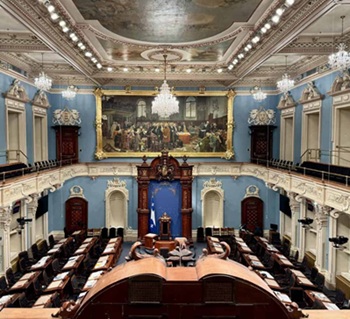
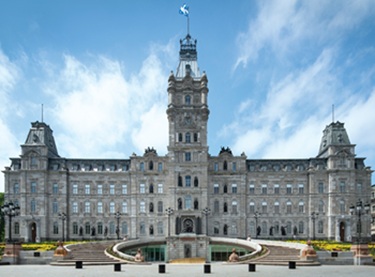
I don’t want to get into any complex details here. I just want to focus briefly on the general question of whether members of Quebec’s National Assembly must swear an oath of allegiance to King Charles III to go about their business in parliament.
The written requirement here appears in section 128 of what we now call the Constitution Act, 1867 (and the oath itself is in the Fifth Schedule). This legislation was originally an act of the Parliament of the United Kingdom known as the British North America Act. 1867.
(3) Old British empire poetry of Constitution Act, 1867 never meant to be taken literally
It probably should be a requirement of Canadian public life that anyone who wants to seriously debate public policy issues that in any way touch on “the constitution” must actually read the Constitution Act, 1867 (along with its 20th century update in the Constitution Act, 1982).

Just to start with, the 1867 Act is written in a practical but still essentially poetic 19th century language of the global British empire. This language is in some respects effective and impressive. But it was never meant to be taken altogether literally even in 1867 (let alone 2026).
The bottom line to me is that the preamble to the Constitution Act, 1867 does generally and very importantly declare that modern Canada is to have “a Constitution similar in Principle to that of the United Kingdom.”
This “unwritten” part of our Canadian Constitution broadly covers much that is left out in the far from definitive text of the Constitution Act, 1867. (There is, eg, no specific mention of a Prime Minister in the 1867 document.) And I think it is quite against the defining spirit of the Westminster parliamentary democracy pioneered in the United Kingdom to aggressively urge that “Constitution not an ‘à la carte menu’” in reading the Constitution Act, 1867.
(4) Consulting the ghost of Lord Elgin in 1848
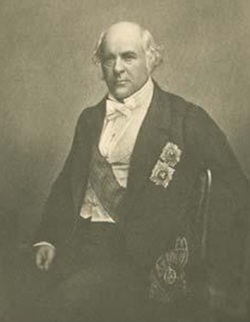
Put another way, it is a very legalistic (in the worst sense) interpretation of the Constitution Act, 1867 to say that in 2026 it requires in some deep rule-of-law sense that Quebec National Assembly members must swear allegiance to Charles III — against the Assembly’s own law making such an oath optional, passed unanimously by all members in 2022.
The politically deft and high-minded British imperial governor Lord Elgin, who presided over the 1848 beginnings of today’s parliamentary democracy in the mid 19th century British North American colonies (and still has an Ottawa hotel named after him), is I think a case in point.
Lord Elgin would not think (it seems to me) that it makes any sense at all to somehow legally coerce members of the National Assembly of Quebec to swear “true Allegiance” to something and someone who means nothing in their 21st century Canadian provincial (but also Quebec national) parliamentary democracy.
I in any case — along with many other present-day Canadian citizens, I’d guess — think all this is altogether free and democratically appalling (and worse)! Why are we the Canadian people even debating the question of whether Quebec MNAs must swear allegiance to King Charles, to behave legally and constitutionally in their Canadian regional parliament at Quebec City ????
It makes no sense, however inoffensive Charles III’s just-trying-to-do-my-job approach to what remains first and foremost the British monarchy may be.
And it is similarly altogether foolish, even if it’s exactly true that “Quebec Liberals and Conservatives balk at PQ’s call to affirm they will sit without swearing oath to King.”
In the bubbly real world of Canadian politics I of course don’t know how this particular future will finally unfold. All anyone can safely predict right now is “Court to rule Monday on whether Quebec MNAs can sit without swearing oath to King.”