PM Mark Carney “isn’t literally Canada’s monarch” .. but his great prime ministerial power does lean on the ancient great power of British monarchs
Nov 21st, 2026 | By Randall White | Category: In Brief
RANDALL WHITE, CANADIAN REPUBLIC NOTEBOOK. TORONTO. SATURDAY, NOVEMBER 21, 2026. Linda Thornback, “a writer from New Brunswick,” has just published an intriguing piece in The Walrus called “When Did Mark Carney Become King? … A former central banker is playing a role usually reserved for royalty.”
Ms Thornback argues : “Obviously, Carney isn’t literally Canada’s monarch, but psychologically, that’s the role he’s been assigned. His approval numbers make more sense if you imagine the poll question not as “Do you like this politician?” but as something closer to “Do you support the King during a national crisis?”
I think there’s something to this argument. But in my view it finally has less to do with Canadian psychology, even in the age of Donald Trump next door, and more to do with Canadian political science.

And the monarchical underpinning of Canadian prime ministers goes at least as far back as Prime Minister William Lyon Mackenzie King in the middle of the 1920s — and especially to Mackenzie King’s (and George VI’s) “Letters Patent Constituting the Office of Governor General and Commander-in-Chief of Canada” in 1947.
The office of Prime Minister of Canada, that is to say, is uniquely powerful. (More so, eg, than President of the United States of America.)
And this power is currently rooted in the vast theoretical power (and earlier practical power — see eg Henry VIII) of the monarch of the United Kingdom. (In whom the “Executive Government and Authority of and over Canada is … vested,” according to section 9 of what we now call the Constitution Act, 1867.)
The earlier careers of PM Carney (born in the Canadian Northwest Territories and raised in Edmonton, Alberta) as Governor of both the Bank of Canada and then the Bank of England — along with his coming into office during the second term of a President Donald Trump inclined to see Canada as no more than a so-called 51st state of the USA — have arguably given him a unique understanding of the ultimate monarchical powers of Canadian prime ministers.
Yet it was Mackenzie King’s 1926 conflict with Canadian Governor General Lord Byng (a UK aristocrat appointed by the British government across the sea) that finally led to the modern office of Governor General and Commander-in-Chief of Canada.
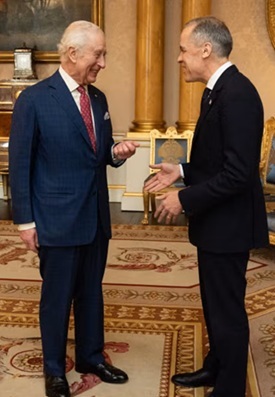
This office as the monarch’s resident local representative in Canada , nowadays effectively appointed by Canadian rather than British prime ministers (on must-be-taken advice to the King who lives in the United Kingdom) has, as George VI declared in the 1947 Letters Patent can now legally and constitutionally “exercise all powers and authorities lawfully belonging to Us in respect of Canada.”
Moreover, though it is King George VI who legally and theoretically speaks in the 1947 Letters Patent, the document concludes with “BY HIS MAJESTY’S COMMAND, W.L. MACKENZIE KING, Prime Minister of Canada.”
And this, added to the present-day reality that the Prime Minister of Canada effectively appoints the Governor General of Canada (again who must finally follow the Canadian prime minister’s advice on all important issues), underlines the extent to which the great power of the Prime Minister of Canada reincarnates the great power of such ancient British monarchs as Henry VIII (who among other things had his second wife Anne Boleyn beheaded!).
As I noted in my last post on this site, the wreaths laid by the Governor General at the national war memorial on Remembrance Day are nowadays said to be from “The People of Canada/Le Peuple Canadien”, not the monarch who lives in the United Kingdom.
Yet the the monarchical underpinning of the prime minister’s great power in the government of Canada today also suggests that no prime minister (or politician aspiring to such a role) is likely to urge any transition from constitutional monarchy to parliamentary democratic republic.
And this is largely because in such a new Canadian republic the Governor General (and head of state in theory as well as practice) might actually be chosen by the People of Canada directly or indirectly (through the people’s elected representatives in parliament).
Canada will only become a parliamentary democratic republic in theory as well as practice when the great majority of the real-world People of Canada insist upon it.