2026 US midterms — Can Canada and Canadians now go back to the late 1980s .. when the first US-Canada Free Trade Agreement began to gel?
Nov 7th, 2026 | By Randall White | Category: In Brief
RANDALL WHITE, NORTH AMERICAN NOTEBOOK, TORONTO. FRIDAY,NOVEMBER 6, 2026. From its earliest 17th century beginnings modern Canada has had a complex relationship with what became the United States of America in 1776 (after its various earlier beginnings in the 17th century).
And one of the many insane features of Donald Trump’s view of the continental world he lives in is that if Canada (or rather the 10 provinces and three territories of Canada today) ever did become the 51st state (and beyond) of some new United States of North America, Trumpian and probably all other Republicans would almost certainly never win another federal election. As the old- school Canadian historian Frank Underhill explained long ago : “Canadians usually vote Democratic in American elections” (or words to that effect).

So at least the great majority of Canadians (75% say, as in the recent Alberta referendum?) are bound to be pleased by the 2026 US midterms, which have brought (as now begins to become clear enough on the historical front) the greatest Democratic party electoral triumph since the immediate post-Watergate era in the mid-1970s.Or as the UK-inspired Economist magazine has urged : “Midterm voters delivered the biggest wipeout in half a century … The Democrats have won the biggest congressional landslide in 50 years.”
Or again as Aidan Mc:Laughlin at Vanity Fair’s “Party Animals” has more colourfully explained : “Good afternoon from Washington … The town, one of the bluest in the country, is in a state of stunned ecstasy as it struggles to process the mind-bending midterm election results. Democrats won the House, the Senate, and a majority of governorships, penetrating deep into historically red strongholds like Texas, Kansas, Mississippi, and South Carolina.”
On still another angle Fintan O’Toole has explained on The New York Review site : “Religious faith has long been one of the motors of progressive politics in the US, and one of the stories of the midterms is the extraordinary success of James Talarico in Texas and Adam Hamilton in Kansas—both candidates who defined themselves through their Christian beliefs. They won in part because those convictions signaled moral decency. In the face of ICE assaults on workers and families, Love Thy Neighbor turned out to be a pretty effective political admonition.”

In a related vein, the indefatigable Robert Reich in northern California has confessed : “By now I’ve read or seen every major victory speech from Tuesday’s remarkable election. There were many powerful and moving speeches, but in my judgment, the best was from James Talarico, the new senator-elect from Texas. I’ve reproduced it below … I think it’s a harbinger of the future.”
To just read the first few lines of this victory speech by the new senator-elect from Texas, James Talarico, makes clear what Robert Reich means : “We just took back Texas. We just proved that all the money in the world is no match for the people of Texas. We just showed that a politics of division is no match for a politics of love … And we just sent a message to every billionaire mega donor, every trillionaire mega donor, every corrupt defender of this broken political system in this state, in this country: Power belongs to the people.”
As one of the great Canadian majority that usually votes Democratic in American elections , I can’t help but thrill to all this myself. Democracy in America has shown at last that it’s not really dead. Those of us who believe in the related (but still somewhat different) democracy in Canada cannot help but celebrate the US midterm elections of 2026, along with our friends (and enemies like the non-celebrating Mr. Trump), across the lake or the line or short stretch of salt water.

At the same time, like the same great Canadian majority, I have lived through watching the last 10 years of American political history just next door — from Trump I to the Biden Interlude to Trump II. And I don’t think the remarkable American midterm elections of 2026 change anything about Canada’s new strategy for coping effectively with the at least partly US-induced global and regional political, economic, and even cultural turbulence of the early mid-21st century. (Fashioned so impressively by the Prime Minister Mark Carney who so many Canadians quite rationally, in my view, still feel lucky to have looking after the fate of the second-largest political geography and most geographically beautiful country in the world!)
For one thing, Donald Trump is still president of the USA so dangerously next door for the next two years. (He can veto bills from the House and Senate he doesn’t like, and there just isn’t enough bipartisan muscle even in the 2026 midterm Senate to override his vetoes.) And then just today on our giant TV I heard Kentucky Governor Andy Beshear, urging that winning the 2028 presidential election was the deepest Democratic challenge. Trump won’t be able to run then. But eg, the Governor suggested, “JD Vance is in some ways worse than Trump.” (Which raises a final point : even in the 2026 midterms A LOT of American voters still backed Trump Republicanism — and its “51st state” view of Canada.)
Regardless of what the US Democrats so many Canadians like so much better than Republicans do over the next two years, and beyond, I believe it would be a deep historical mistake for Canada and Canadians to now (or now ever) try to go back to the over-aggressive and historically unusual “continentalism” of the Bryan Mulroney Conservative world of the late 1980s, that gave birth to the first Canada-US Free Trade Agreement, which by 1994 had expanded into NAFTA, which later became CUSMA under Trump I, which Trump II has largely ignored.
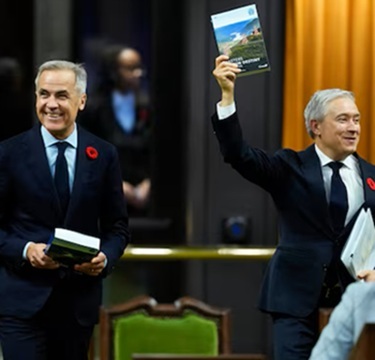
For we Canadians the most important big political event of this past week was the federal budget that François-Philippe Champagne and Mark Carney introduced yesterday. A few big chunks of today’s Canadian economy are closely tied to the USA. And I believe the Carney government will do everything possible to strike an advantageous deal with Washington about this side of our economic life. But, even when Donald Trump is long gone, our serious new future in Harold Innis’s “northern North America” will still lie in what Innis’s disciple of sorts Marshall McLuhan called the global village back in the 1960s. That’s the future Mark Carney is building for Canada. And he and his government in Ottawa should just carry on.