Is Elon Musk a monster (or Meloni, Putin, Trump, Xi Jinping) — and how is it now Out in the West Texas town of El Paso?
Aug 7th, 2026 | By Randall White | Category: In Brief
RANDALL WHITE, NORTH AMERICAN NOTEBOOK, TORONTO. FRIDAY, AUGUST 7, 2/026. With the fabled local “Exhibition Weather” almost about to settle over this Canadian metropolis where I live, I have just been inspired by two pieces in the July 23, 2026 issue of the New York Review of Books.
The first is “Space Oddity … Quinn Slobodian and Ben Tarnoff’s Muskism examines how Elon Musk became the world’s first trillionaire, by selling a vision of the future that very few people would want to inhabit.” This is a review of Slobodian and Tarnoff’s Muskism: A Guide for the Perplexed by the 47-year-old Irish writer (and Dublin resident) Mark O’Connell. (Not to be confused with the Mark O’Connell who is a “Board Director & Investor” and lives in Toronto.)

My second NYRB piece is “The New Ellis Island … A history of five families in El Paso reveals the city’s significance as a bellwether of America’s immigration policy.” This is a review of Jazmine Ulloa’s El Paso: Five Families and One Hundred Years of Blood, Migration, Race, and Memory by the 75-year-old American journalist and eminent immigration specialist Julia Preston, who grew up in Lake Forest, Illinois and now lives in Hoboken, New Jersey (just across the Hudson River from Greenwich Village in New York City).
The long and short of my inspiration is that I was first especially struck by the last few sentences of Mark O’Connell’s review : “Musk’s worldview … is an explicitly antihuman one. But it is also—and this is the point of Slobodian and Tarnoff’s persuasive and vital book—not just Musk’s worldview. It already underpins much of contemporary capitalism and may come to be seen as the presiding pathology in our time of monsters.”
My initial reaction here was to wonder if we do in fact live in a “ time of monsters” right now? Donald Trump, eg, is to me an essentially ignorant schoolyard bully and total jerk who is not remotely qualified to be President of the USA. But I wonder if he has an at all big enough personality to also qualify as a credible monster?

Like more than a few others, I see Elon Musk himself as not much more than an updated Henry Ford, who revolutionized 20th century industrial manufacturing, while aggressively hating Jews and admiring Adolf Hitler (who returned the favour, sitting in his “private office … decorated with a large picture of Henry Ford”). And then I also can’t quite see monsters even in such leaders of our time as Meloni, Modi, Putin, and Xi Jinping. To say nothing of our own PM Mark Carney in Canada and his ilk elsewhere — standing up against whatever real near-monsters there may wherever be.
At the same time, reading Julia Preston on El Paso and environs, immediately after Mark O’Connell on the Monster Musk at first almost made me change my mind. What has been going on along the southern US border lately — and elsewhere in the USA today as the strange adventures of the expanding ICE (Immigration and Customs Enforcement) agency unfold — does in some ways look like the work of real monsters. (And if Donald Trump does not exactly qualify for bad rather than good reasons, someone like his “ideologue in chief” Stephen Miller more than arguably fills the bill.)

Julia Preston (and Jazmine Ulloa) are quite good as well on how the long and twisted relationship between Spanish-speaking Mexico and English-speaking USA USA plays into many current North American monstrosities and/or variations on the theme : “Ulloa begins her history,” Ms Preston writes, “ by reminding readers of an event that should be prominent in any account of the consolidation of the United States as a nation.”
Ms. Preston goes on : “At the end of the Mexican-American War, with the signing of the 1848 Treaty of Guadalupe Hidalgo, perhaps the most spectacular real estate deal in American history, the United States obliged Mexico to accept $15 million for 55 percent of its territory, including modern-day California, Nevada, Utah, and New Mexico, most of Arizona and Colorado, and parts of Oklahoma, Kansas, and Wyoming. Mexico, in defeat, also relinquished its claim to Texas and recognized the Rio Grande as the border, making El Paso ‘a passageway between two uneasy nations,’ as Ulloa puts it.”

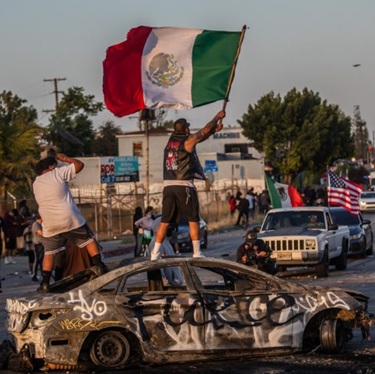
Julia Preston also notes how Jazmine Ulloa’s history of her El Paso, Texas hometown (along with its Mexican companion city of Ciudad Juárez across the river) helps explain the Mexican and American flags at the recent ICE protests in Los Angeles : “There were ‘nerdy Latinos and punk Latinos and later emo Latinos,’ she recalls. ‘There were Latinos who were rich and Latinos who were poor. Latinos who were all shades of black, brown, and beige.’ By her account they all got along, with little judgment: ‘My hometown afforded me the privilege to be all parts of myself—as much Mexican as American, as much from here as from there.’”
Yet in the end Julia Preston lands on serious hope for (now as in the past) getting around whatever real and unreal monsters may be lurking in the present and future of Democracy in America : “What is new in Trump’s second term is the scale of the deportation blitz. The whole country is becoming a borderland, as DHS tries to achieve Trump’s goal of deporting one million people this fiscal year … ”
Again Ms. Preston goes on : “Also new is the widespread resistance to Trump’s crackdown. In Los Angeles, Chicago, Minneapolis, Charlotte, and many other places where ICE arrived—including El Paso—citizens have rallied with whistles and horns to alert immigrants of danger, tracked agents’ movements with phone cameras in hand, provided food for families too scared to leave their homes, and even offered places for them to hide … Polls show that Trump’s assault is losing public support.”
The immediate hope of course is that those who seriously believe in the continuing future of Democracy in America will emerge from the November 3, 2026 midterm elections with enough fresh strength to at least start to consign the Stephen Millers of the USA USA today to the fabled trash heap of history.
Meanwhile, some old folks even up here in the far north of North America will continue to remember Marty Robbins’s 1959 country western classic — “Out in the West Texas town of El Paso/I fell in love with a Mexican girl/Nighttime would find me in Rosa’s Cantina/Music would play and Feleena would whirl.”
(And meanwhile again best of luck on November 3 to potential new US Democratic senator from Texas, James Talarico.)