Goodbye, Lieutenant – Columbo and me (1927—2011, 1968—2003)
Jun 26th, 2011 | By Randall White | Category: USA Today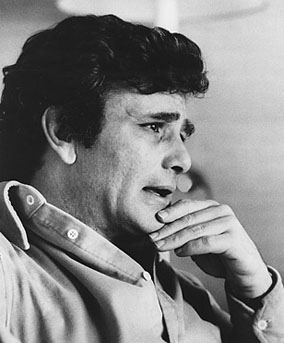
Peter Falk in 1963. A New York City native and actor in his mid 30s. By this point his breakout role in the 1960 movie Murder Inc. was the “miracle” that “made my career.”
The death of the actor Peter Falk this past Thursday, June 23, 2011, at his home in Beverly Hills, California, at the age of 83, is worth commemorating for a host of good reasons. But I have a particular reason myself.
Peter Falk – and more exactly, or especially, in his “defining role” as Columbo, which ran intermittently from 1968 until 2003 as a TV show and a series of television movies – is (almost) the only Hollywood actor anyone has ever told me I resemble. And I have been told this often enough, by people who have never met and do not otherwise know each other, to suspect that it probably does contain some slight grain of truth.
According to the Wikipedia article on the TV series: “Lt. Columbo is a shambling, disheveled-looking, seemingly naive Italian American police detective who is consistently underestimated by his fellow officers and by the murderer du jour … Despite his unprepossessing appearance … he shrewdly solves all of his cases and secures all evidence needed for indictment. His formidable eye for detail and meticulous and dedicated approach become apparent only late in the storyline.”
I like to think that I dress a little better than this. I am not Italian American. (Though neither was the East European Jewish Peter Falk.) What some people have seen of Falk/Columbo in me, I choose to believe, is that despite my unprepossessing appearance etc, I shrewdly solve all my cases and secure all evidence needed for indictment.” (What people have seen, that is to say, is NOT the “shambling, disheveled-looking,” etc, etc. Of course I am not a police detective either, or an actor, but …)
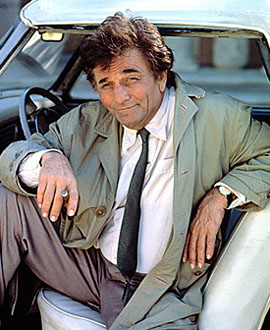
Peter Falk in his “defining role as Columbo” – which ran from 1968 until 2003 as a TV show and a series of television movies.
As I read through the various recent obituaries and retrospectives on Peter Falk’s career, I see a few other things I can admire and/or identify with. And this might further explain why others have seen what they have seen.
As one source reports, eg, “Columbo … never had a first name.” He nonetheless “presented a contrast to other TV detectives. ‘He looks like a flood victim,’ Falk once said.” Even so, the actor went on: “Underneath his dishevelment, a good mind is at work.” From another source I discover that “Mr. Falk” also offered a solution to the ultimately formidable detective’s unknown first name. He “joked that it was ‘Lieutenant.’” (And that, for better or worse, is a joke I wish I had thought of myself.)
Earliest days …
One thing I did not at all know about Peter Falk until I started reading his obituaries and so forth a day or so ago was that his “right eye was surgically removed when he was three because of a retinoblastoma [ie cancerous tumour of the retina]; he wore a glass eye for most of his life.” As Richard Corliss has explained in his Time magazine retrospective, the future Los Angeles TV Lieutenant had “had one of the great loopy stares in movie history, courtesy of a glass eye that was the trophy from a childhood disease.”
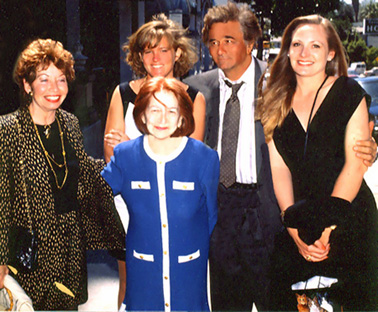
With first wife Alice Mayo, mom Madelyn, daughters Catherine and Jackie. Falk married “his fellow Syracuse University student Alyce Mayo” in 1960. They adopted two daughters but divorced in 1976.
I can’t say I have anything exactly like this myself. But I can report that my left eyebrow is upside down, so to speak, as a result of a youthful accident. (I hope most people do not notice this, any more than I figured out that Mr. Falk’s loopy stare was attributable to a glass eye.)
I can identify to a somewhat greater degree with Peter Falk’s formal education and early employment. In 1951 he graduated from the New School for Social Research in New York City (where he had been born, in 1927) with a bachelor’s degree in literature and political science. Then he obtained a Master of Public Administration degree at the Maxwell School of Syracuse University in upstate New York, in 1953.
With this academic background, but without any remotely serious enthusiasm, he wound up as a management analyst with the Connecticut State Budget Bureau in the state capital at Hartford.
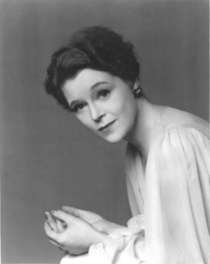
Eva Le Gallienne (1899-1991 – “a remarkable woman and a remarkable force in the history of American theatre” – told the late 20-something Peter Falk in the State of Connecticut public service that he should be a professional actor.
Falk’s first stage appearance, however, had been at the age of 12 in a summer camp production of The Pirates of Penzance. This gave him an acting bug. His parents’ scepticism about the practical prospects of actually making money this way put the bug on a back burner until later in his 20s. But while working with the Connecticut State Budget Bureau he joined a community theatre group called the Mark Twain Masquers.
The Masquers were subsequently supplemented by a professional acting class once a week in Westport, Connecticut, with the English-born actress Eva Le Gallienne, by then in her mid 50s. With her encouragement, he finally left his job with the Budget Bureau in 1956, and moved to Greenwich Village in New York City, to pursue an acting career.
The miracle career …
At about this point in his life, the similarities between Peter Falk’s experience and my own, some 18 years later, start to become extremely superficial.
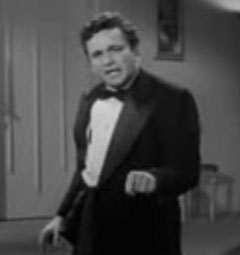
New York Times film critic Bosley Crowther called Murder Inc in 1960 just “an average gangster film,” but he nonetheless praised Peter Falk's “amusingly vicious performance.”
In 1960 he played the supporting role of 1930s killer Abe Reles in a movie called Murder Inc. The New York Times film critic Bosley Crowther, said the movie was only “an average gangster film.” But he praised Falk’s “amusingly vicious performance.” Falk was nominated for a Best Supporting Actor Academy Award for Abe Reles. And this became his “breakout role” – the “miracle” that “made my career.”
The next year Falk was nominated for another Oscar for his role in Frank Capra’s last movie, Pocketful of Miracles. His other 1960s movies included It’s a Mad, Mad, Mad, Mad World, Robin and the 7 Hoods, The Great Race, and Penelope (with Natalie Wood, and in which Falk played the police detective Lieutenant Horatio Bixbee – who may or may not have been a precursor of Lieutenant Columbo a few years later).
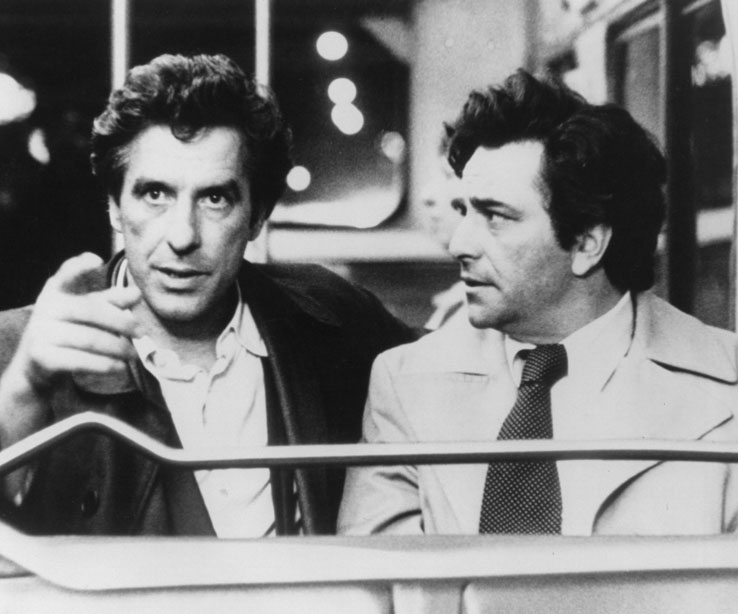
Falk was a close friend of independent film director John Cassavetes and earned some kind of higher credentials for his appearances in Cassavetes' films Husbands (1970) and A Woman Under the Influence (1974).
Some might say that Peter Falk as a heavyweight movie actor never quite repeated his first crescendo in the early 1960s. But his TV career had begun in 1957, and he was nominated for an Emmy Award in 1961, for his performance on an episode of the short-lived ABC series The Law and Mr. Jones. In 1962 he won an Emmy for The Price of Tomatoes, a Dick Powell TV drama. His first television series was in the title role of the drama The Trials of O’Brien, in which he played a lawyer. The show ran in 1965 and 1966 but was cancelled after 22 episodes.
In 1968, with Peter Falk in his early 40s, his TV odyssey of Lieutenant Columbo began. And it would survive through various intermittent incarnations all the way down to 2003 – when Falk was in his mid 70s. As it happens, he “did not originate the role of Lt. Columbo of the Los Angeles police. Bert Freed first played Columbo in a 1960 teleplay.” Even more surprisingly: “Nor was Mr. Falk the front-runner for the part when NBC wanted to revive the character in 1968 for a made-for-TV movie, Prescription: Murder. The network hoped to cast entertainer Bing Crosby for that program.” (I cannot see this at all myself, but it is apparently true.)
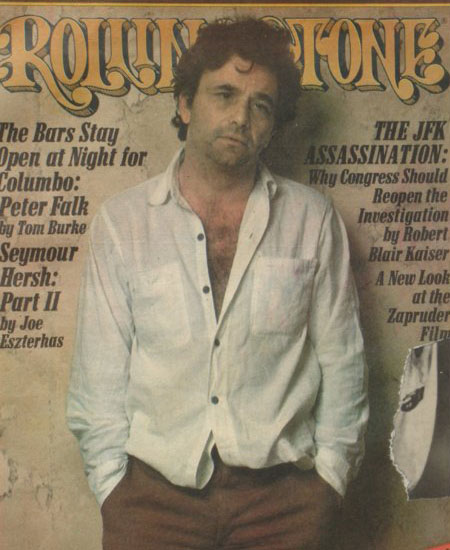
Making the cover of Rolling Stone on April 24, 1975 was a sign that both Peter Falk and Lieutenant Columbo were approaching some at least minor iconic status.
All told, Falk eventually appeared in 69 Columbo “episodes” – over 11 intermittent “seasons” and with two additional “pilots” and eight “specials.” (These complete works, as it were, are documented in varying degrees of detail under the “Episode Guides” heading on The Ultimate Columbo Site! “created by Stephen Burns, Bob Hoey and Ted Kerin.”)
Lieutenant Columbo was the unambiguous defining role of Peter Falk’s career – and the Los Angeles police detective won him four more Emmy awards. But even without Columbo he would enjoy a credible TV, movie, and occasional stage acting career. As just one case in point, he “also appeared in a number of art house favourites, including the semi-improvisational films Husbands [1970] and A Woman Under the Influence [1974], directed by his friend John Cassavetes, and Wim Wenders’ Wings of Desire [1987], in which he played himself.”
Falk’s later TV and movie credits included The Princess Bride (1987), Cookie (1989), The Sunshine Boys (1995), The Lost World (2001), and The Thing About My Folks (2005). He made his last movie, American Cowslip, in his early 80s, in 2008. (He had told the New York Times in 1990: “Never have thought about setting goals – so I never had to worry about achieving them. My career just sort of happened. And as a strategy? It hasn’t worked out all that badly.”)
A summing up …
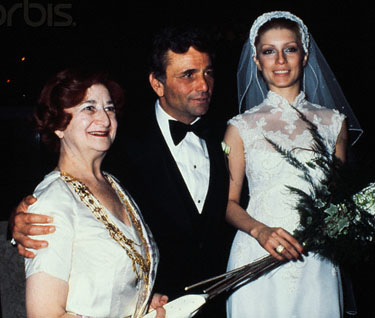
With second wife Shera Danese, and mom Madeline, at Shera and Peter’s wedding in Los Angeles, December 1977.
On June 4, 2009 Shera Danese, Peter Falk’s second wife, of some 31 years (although they “filed for divorce twice and reconciled each time”) put out a poignant press release. It noted that when her “loving husband … became ill shortly after a surgical procedure, one of my main concerns was to respect his privacy.”
I also find myself wanting to respect the privacy of Peter Falk’s last few years – in some degree at least. But I don’t think it is telling too many tales out of school (it is all available on the net, in any case) to say that after some apparently quite extensive dental surgery a few years ago, he slipped into an increasingly severe case of dementia and Alzheimer’s disease.
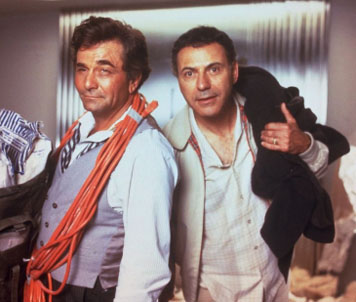
In 1986 Falk appeared in John Cassavetes’s last and alas unfortunate movie, Big Trouble, with Alan Arkin, Beverly D'Angelo, Robert Stack, and Charles Durning. The fate of everything in Hollywood, some wise person once said, is finally serendipitous.
Even at the height of his career Falk’s private life seems to have remained comparatively private. But it is certainly well known that he married “his fellow Syracuse University student Alyce Mayo” in 1960. They adopted two daughters but divorced in 1976.
Then: “A year later [on December 7, 1977, in fact] Falk married actress Shera Danese, who regularly appeared on Columbo,” and “was 21 years his junior.” (Ms. Danese also “played the role of the prostitute Vicky in the film Risky Business [1983] featuring Tom Cruise and Rebecca De Mornay in the lead roles. Her roles on television included episodes of One Day at a Time, Serpico, Baretta, Three’s Company, Kojak, Family, Hart to Hart, Starsky and Hutch, and Charlie’s Angels.” She also “has the distinction of having played a suspect or victim in more episodes of Columbo than any other actor.”)
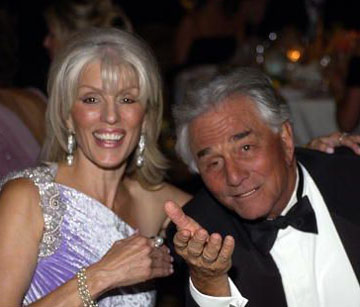
Peter Falk and (second) wife Shera Danese pose during dinner at the 11th Annual St. John's Health Center Caritas Award Gala, on May 21, 2004 at The Regent Beverly Wilshire Hotel in Beverly Hills, California.
I have never thought myself that Columbo was anything more than casually interesting TV. I am virtually certain that I have not seen all 69 “episodes.” My only even vaguely systematic encounter with the program has been over the past few days, researching this commemorative piece. And I think Peter Falk at large – as an actor and as a fellow human being who haphazardly earned an MA in public administration before finally settling into the career he really wanted – is a considerably more interesting character than his defining role.
I also think Peter Falk’s Columbo himself is a somewhat more intriguing character than he is usually given credit for. (He drives, eg, on Falk’s own ultimate inspiration, a Peugeot 403 – a rare model of a rare enough brand of French automobile: Columbo isn’t just dishevelled but ultimately brilliant: he’s also, in his own way, hip and cool, or something like that.)
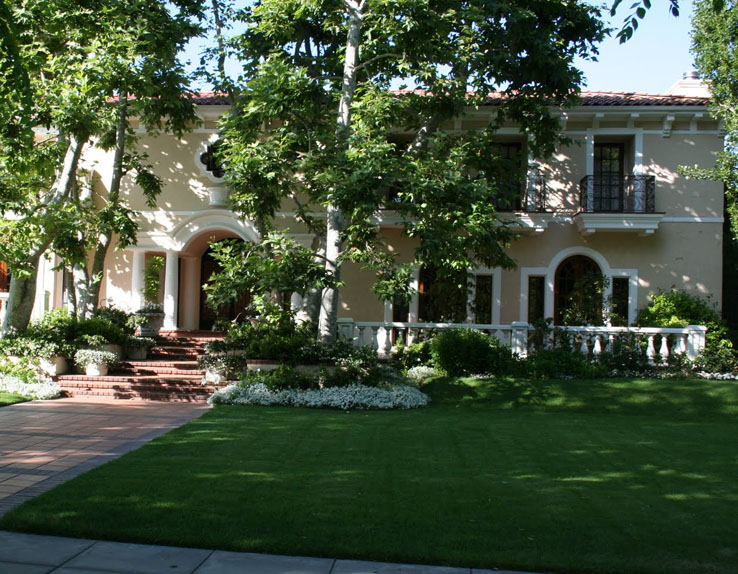
The Falk home in Beverly Hills, summer 2010, where Peter Falk still lived with his second wife Shera Danese – and also the home where he died, June 23, 2011. The photographer, Mary Ann Fiebert, “was told he is suffering from dementia and at times can be seen being pushed in a wheelchair on the sidewalk seen in front of his home. That would have been a sad sight to see.“ Another source points out that for some time at this point, Falk himself had been living “in the guesthouse at his Beverly Hills mansion, which has been specially converted to facilitate 24-hour care.”
In the very end, what has made Colomobo so popular I think, is the way in which he caters to the self-serving ideas so many of us have about ourselves. Many if not most of us feel that we too are underestimated by our fellow officers and by the murderer du jour. We believe that despite our unprepossessing appearances, we shrewdly solve all of our cases and secure all evidence needed for indictment. I know that I certainly identify with this kind of happy perception. And that may very well be why I have been told often enough, by people who have never met and do not otherwise know each other, that I somehow actually do resemble the Peter Falk whose defining role was Lieutenant Columbo.
I can only conclude by seconding the epilogue offered by Mike Spinelli at jalopnik.com: “RIP Peter Falk, you magnificent bastard. Thanks for making trench coats, french cars, absent-mindedness and eye-tropia cool. Or at least, anti-cool.” (Though I hasten to add that I am not absent-minded – well, not too absent-minded, yet. I do not, again so far, suffer from    eye-tropia, I think. And I have never driven a french car!)

Probably a million people have already said this, but Columbo’s first name was Frank.
I absolutely adored Peter Falk and his portrayal of Columbo – never missed an episode and have a collection of videos at home which I regularly watch with just as much enthusiasm as when they first aired. I was so, so, so sad when I heard of his passing in 2011. I still smile when I read articles about him – this article is very informative and sweet. Thanks.
I loved watching Peter Falk as Columbo.Seen every episode a zillion times.
Drove past his house once in the 80s,I wish so much I could have met him.
Will always be missed.
Rest in peace to a great actor who provided so much good entertainment for over 50 years, and thanks to Ms. Le Gallienne for recognizing his genius/potential.
Very nice article. My husband and I are enjoying watching Columbo -look forward to each episode. (I also watched it when it originally aired, but enjoying it even more now.)
I also in addition to all known movies mentioned, enjoyed his acting in Hallmark movies. He gave such a comforting familiar smile that shown through all his work and appearances. His friends mentioned I also watched and envy their closeness through the years. Thank you to all who comforted him in his last days. He played an angel and was one.
March 31, 2015
To Whom It May Concern,
What I loved most about Columbo was the fact that he was a gentleman and shied his love for
The guilty party.
He gave them due respect through out it all.
What a great man? I wish that I had met him personally.
Anita
I loved watching peter Falk as Lt. Columbo back in the 80’s as well as now on youtube. He was a legend in his own rights! I don’t think any other actor could play that character as good as he did!!!
I loved Peter Falk. He was a great actor, I never missed a episode of the Colombo show, in fact I continue to enjoy watching the reruns of the show. He was wonderful in that show. 🙂
Peter Falk is loved because was so genuine. The world seemed like a better place when he was with us. He is missed. He was an original and no one will ever take his place.
Cute,classy,humble,devoted to his wife,sharp,hilarious,professional, colombo was him, he was colombo.What a talent! I love u peter falk, I shall always miss you… may the Lord God have you in the palm of His Hand. : )
What a lovely man, I am fascinated with him playing the part of Lieutenant Columbo, I love watching all the reruns despite having the full Columbo collection on dvd. He has kept me amused for many years and always puts a smile on my face. Thank you Peter Falk.
Im so sad that Peter Falk passed away. I never really liked mystery or detective shows until I seen Columbo. I love every episode & I love how the suspects get annoyed by his intrusions & act like he’s some fool & then he throws the evidence right into their face. He was the best & there will never be a greater detective show than Columbo.
..
In episode 66 “No Time to Die “, Columbo shows his ID to the suspect late In the show. If you stop the action on your dvr, you will see that his name is Frank Columbo….just a little trivia that few people know!
Watcing Murder Under Glass as I write this..
Named my dog Columbo 20yrs ago…miss them both very much. Love to catch little mistakes now that i have all the episodes and watch some weekly..my favorite celebtrity, then, and now..RIP Peter…look forward to meeting
In the immortal words of an irreplaceable iconic character, “there’s just one more thing,” I love that kicker. You knew he had the perpetrator when he said those words.
Columbo set the standard for which all who have tried to follow…impossible. Love the character and certainly the man who brought it to life. I adore him as Max the angle on the Hallmark movies. So sad for his family and what they’ve lost, but what a great legacy left them. Thankfully we have syndication & DVD’s.
My mum and i watch over 6 episodes a week of columbo and as soon as we hear the opening line we can tell you who killed who, how and why. But we never got to see the “mrs columbo”. However, we watch them over and over again. I loved his whistling tune and excuse me sir just one more thing, i will have the chilli…….
My husband and I absolutely love Peter Falk and his Columbo series. Every Saturday and Sunday afternoon we look forward to a cup of tea, a piece of cake and a Columbo episode! We wish we had had the pleasure of meeting him. He seemed like an amazingly beautiful human being inside and out. We thank you for giving us such pleasure of watching LA in the 70s with all its fabulous architecture, fashion, decor, and scenery, not to mention the automobiles of the day. If we could be transported back to any time in history, it would be in the 1970s with Peter Falk at the wheel. RIP you wonderful man. We miss you. xx
Columbo is just the most fabulous prog ever made love peter love the whole damn thing and love the this old man he played one he played nick nack on my drum rip you fab fab man x
Ps I’m from England and would love to visit peters resting place I hear it’s not open to the public can anyone please tell me if that’s so kind regards sue
Hello Sue from England : If you Google “visiting hours for grave of Peter Falk†the answer you get is 8AM–6PM, at Pierce Brothers Westwood Village Memorial Cemetery in Los Angeles.
The Daily Woo website actually visits the grave on You Tube at https://www.youtube.com/watch?v=C4VwqQKLBmM .
For more on “The Grave of Peter Falk” see
http://www.seeing-stars.com/ImagePages/PeterFalkGravePhoto.shtml .
The particulars of the cemetery are PIERCE BROTHERS WESTWOOD VILLAGE MEMORIAL PARK AND MORTUARY, 1218 GLENDON AVE, LOS ANGELES, CA 90024 | 310-474-1579. For an email contact form, that you might use to check on the hours and public availability of the site with the horse’s mouth you can consult the cemetery website at
http://www.dignitymemorial.com/en-us/about-us/contact-us.page .
Best of luck, RW.
Thanks Randall x
Hope to visit this year x
Just off to watch my beloved columbo now brilliant