Blue Jays 50th anniversary 2026 — can Vladdy’s heroes still survive and even thrive after “What a Ride” in 2025
Mar 26th, 2026 | By Rob Sparrow | Category: In Brief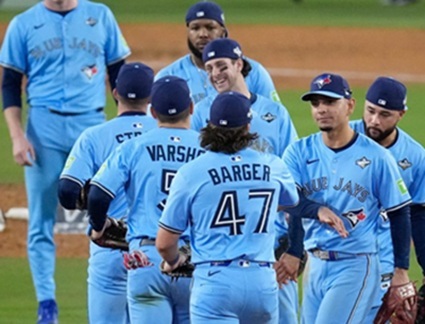
SPECIAL FROM ROB SPARROW, HIGH PARK, TORONTO. MARCH 26, 2026.The 2025 Toronto Blue Jays did everything except win the last game. That is what makes them so unforgettable, and so difficult to place cleanly in the pantheon of Blue Jay franchise history. They were not quite champions, yet they were too large, too dramatic, to be tucked away with some of the other Blue Jay teams that so came before them.
They went from worst to first, from the stale disappointment of a 74-win 2024, to a 94-win division title, from “paper tigers” who perennially disappointed in crunch time, to dispatching the Yankees in the ALDS and Mariners in the ALCS to become the American League’s last survivors. Arriving in the World Series riding a momentum that took them to within two outs of the first Blue Jays World Series title since Joe Carter’s swing sent an entire country into delirium. They almost had their moment : they came that close.
A) What a Ride!!! The Thrilling Toronto Blue Jays of 2025
It is tempting, in retrospect, to say the season ended in heartbreak. “It breaks your heart”, the late MLB commissioner A. Bartlett Giamatti famously wrote of baseball, “it’s designed to break your heart”. Yet that is too small for the scale of what happened. This was not a neat paperback tragedy. This was a ten-day opera in seven acts. The 2025 World Series, by any serious argument, belongs in the short list of the greatest ever played, and its seventh game may have been the most deliriously excruciating winner-take-all game the sport has ever produced. The Jays and Dodgers played 73 innings in the series, the most in World Series history and produced many unforgettable moments: the Barger first pinch-hit grand slam in series history in Game 1, Yamamoto’s complete-game masterpiece of Game 2, the 18-inning madness of Game 3, the back-to-back responding haymakers of Game 4, the rookie revelation of Trey Yesavage and his 12 strikeouts in Game 5, the ball logged in the wall controversy and sudden ending in Game 6, and then the final crescendo: an 11-inning Game 7 in which everything seemed to happen, and then happen again.
Game 7 was, by every statistical and emotional measure, the greatest game ever played. The game featured seven “Golden Pitches,” those impossibly rare moments when a single pitch can win or lose the World Series for either side. Golden Pitches had to that point only been thrown by eight pitchers, to 14 different batters, over the course of the 120+ years since the World Series came into existence. As for drama, Baseball Reference’s Championship Win Probability metric recorded nine separate plays where the title-winning odds shifted by at least 15% — no game in baseball history had ever seen more than seven.
Three of those plays ranked among the top twelve most impactful in World Series history – no other World Series game played had more than one:
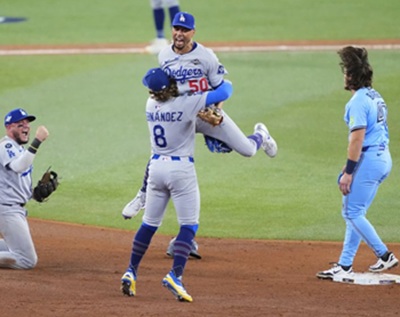
- Mookie Betts’ Double Play (+46.2% cWPA): In the bottom of the 11th, with the winning run at the plate, Alejandro Kirk hit a broken-bat grounder to Betts. The resulting 6-4-3 double play was only the second time a World Series ended on a twin killing, a moment that ranks as the “biggest out” recorded in championship history
- Will Smith’s 11th-inning HR (+41.03% cWPA): A solo shot that broke a 4-4 tie with two outs and the bases empty. Smith became the first player in MLB history to homer in extra innings of a World Series Game 7.
- Miguel Rojas’ 9th-inning HR (+34.91% cWPA): With Toronto two outs from glory, the unlikely Rojas—a man who had not hit a home run on a right-handed pitcher all year—launched a 3-2 hanging slider from Jeff Hoffman into the night, becoming the only player in history to hit a game-tying ninth-inning home run in a Game 7.
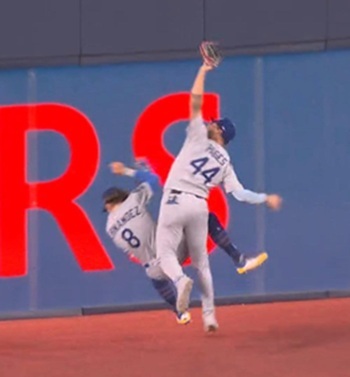
Yet it was not just those big moments, it was the microscopic ones as well. The conservative lead at third by Isiah Kiner-Falefa that likely cost the winning run in the ninth. The chances, three different times, with a man on second and nobody out, to score the run that would have got the Jays to their magic 5, they were an amazing 71-4 when scoring more than five runs during the season. The 300 fewer RPMs than normal on the slider Jeff Hoffman guided rather than ripped, that Miguel Rojas departed to the Blue Jay bullpen. The Andy Pages catch from nowhere that covered 121 feet at 29.2 feet per second, one of the greatest clutch defensive plays ever made in a World Series. Yes, there were bigger moments, but baseball games of this magnitude are built out of tiny acts of courage and caution. Toronto lost by inches and by instincts.
And so, the 2025 Blue Jays become something rarer than champions: a team remembered not only for what it achieved, but for how it made people feel. For 29 October days into a chilly November evening, they made the country feel singularly together. Their season gave the fans a summer of pleasure, and an autumn of nerves, and then just as we needed them the most…this thrilling band of brothers left us…to face the intolerably long winter alone…
B) A Team of Uncommon Men – The Alchemy of Team Chemistry
“We are a team of uncommon men,” Ernie Clement said, leaning on a quote from Herb Brooks, after their rebound win in Game 4 of the World Series, following the heartbreak of the Game 3 18-inning marathon. “I think a normal team would have folded today. And we’re not normal”. In the analytical, mercenary world of modern Major League Baseball, it is rare to find a clubhouse that genuinely functions as a “band of brothers,” but the 2025 Blue Jays caught lightning in a bottle. They were a team whose sum was demonstrably greater than its parts, fueled by what author Joan Ryan calls the “science of team chemistry”—an interplay of forces that doesn’t manufacture talent, but ignites it.
n her seminal book on team chemistry, Intangibles, Ryan argues that “team chemistry is a combination of physiological, social, and emotional forces that elevates performance.” She identifies seven archetypes – Sparkplug, Buddy, Kid, Sage, Enforcer, Jester, Warrior – that define a genuinely cohesive team. The 2025 Blue Jays as a group embodied all seven:
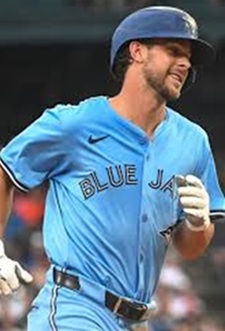
The Sparkplug was Ernie Clement — the absolute heartbeat of the playoff run. You do not set the all-time MLB record for hits in a single postseason (30 hits across eighteen playoff games) without an infectious, hair-on-fire energy that makes the whole dugout believe it is invincible. Broadcaster Dan Shulman, called him “about the most likeable human being I’ve ever met in my life.” Clement played every game with the unselfconscious joy of a child in a backyard. He was the emotional thermostat of the clubhouse, and he kept it permanently set to believe.
The Buddy was Daulton Varsho — the defensive safety net, the glue man whose relentless hustle and quiet reliability created a foundation of psychological safety. Teams do not become intimate by accident; they become intimate because some players make support feel normal. Varsho’s ability to connect to all, made him a player whose consistent support sustained teammates through the grind of a long season. He embodied the selfless ethos the Jays kept talking about, and his all-out style on the field told his teammates, day after day, I’ve got your back.
The Kid was Trey Yesavage — the wunderkind with the incredible rise to the big leagues and the even more ridiculous poise. A 2024 first-round pick who tore through five levels and then through playoff lineups, he gave the team not only outs but innocence, that necessary ingredient on a great team whereby impossibility is not yet understood as impossible. When he declared himself “built for this,” he was not posturing. He was announcing a truth the postseason would confirm. The Kid archetype is not just youth, it is fearless youth, that reminded the veterans why they loved the game in the first place.
The Sage was Chris Bassitt — the cerebral veteran who redesigned the very layout of the Toronto clubhouse to ensure no group became siloed and so that pitchers and position players mixed together. He was the stabilize-and-mentor force who spent countless hours with coaches and analytics staff breaking down opposing hitters, who swallowed his pride to contribute brilliantly out of the bullpen in seven postseason game, and said “it’s hard to replicate true love” the night the season ended.
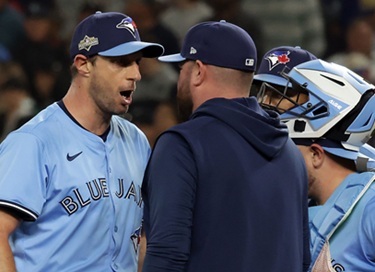
The Enforcer was Max Scherzer — the forty-one-year-old, three-time Cy Young Award winner whose intensity and refusal to leave the mound in the ALCS set a standard of ferocity that no teammate dared not meet. Scherzer’s role was not merely to glare and growl, it was to insist that standards mattered. Teams that are all vibes and no teeth do not survive October, he gave them that edge teams need for battle. He also gave them perspective, the authority of a man who had seen enough baseball to know that rare things were happening around him. “I never thought I could love baseball this much,” Scherzer said through tears after Game 7. “My love for the game was so strong because of their love for the game.”
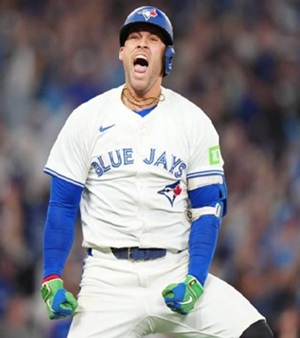
The Jester was George Springer — the tension-breaker, the pressure-release valve, the veteran who orchestrated celebrations and diffused tension with laughter. The season is too long, too taut, too psychologically punishing for a team to remain locked at the same frequency. That matters more than outsiders tend to understand, great teams need laughter and joy. He was the master of the emotional reset, keeping the boys loose through the white-knuckle weeks of October. Springer helped the room exhale, with his humour and well as his play, none more so with his “Springer Dinger” in Game 7 of the ALCS that catapulted the Blue Jays to the World Series.
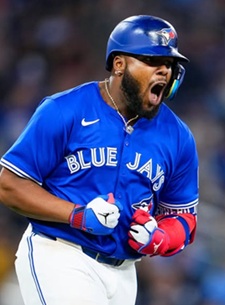
And The Warrior was Vladimir Guerrero Jr. — he was the center of gravity, the player the others climbed onto in the biggest moments, the one whose confidence could be borrowed by the rest of the room. Clement more or less admitted it, “we’ve been jumping on Vladdy’s back all postseason.” That is what Warriors do. They make others braver. Guerrero’s postseason was monstrous, but his emotional leadership mattered just as much. He was the one who told the room to get their heads up and put on some music. Even his swagger was an act of service.
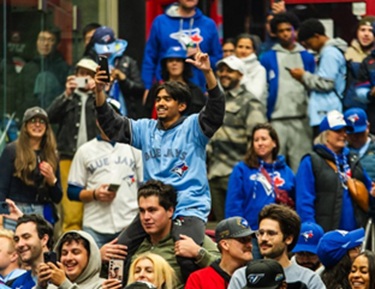
Those Intangibles became Toronto’s competitive edge in 2025. And that is why the ending, for all its devastation, felt almost secondary to the separation. In the clubhouse after Game 7, the grief was not only about losing a title. It was about losing one another, “30 best friends” as Ernie Clement described the team. Baseball always breaks teams apart, contracts expire, careers curve downward, front offices intervene, time does what time does. But for one season, the Blue Jays discovered the most elusive advantage in sport, not just belief, but shared belief. Not just a roster, but a brotherhood. In a game where so much is measurable, that remains one of the few advantages that can only really be felt. The 2025 Jays felt it, so did everybody watching…
C) The Vladdy Era: Warrior and Cornerstone …
The most important thing the Blue Jays did early in the 2025 season may not have shown up in a box score. It was not a trade, not a lineup decision, not a pitch-design tweak, not one of the smaller clever moves that modern front offices love to turn into self-congratulation. It was a declaration. By signing Vladimir Guerrero Jr. to a 14-year, $500 million extension, the Blue Jays did not merely secure a first baseman. They secured a cornerstone and a direction. “This is my second house. I always thought I would be a Blue Jay forever, and that’s what happened.” said Vladimir Guerrero Jr.
The extension also changed the psychology of the 2025 season itself. Had Guerrero remained unsigned, every losing streak would have produced deadline speculation, every rumor would have carried existential undertones, every question about the front office would have doubled as a question about whether the team should be sellers. By signing him, the Blue Jays removed the poison of uncertainty. The contract answered the question that had hovered over the franchise for years as they slow played contract negotiations with both of their homegrown stars Vladdy and Bo. What exactly are the Blue Jays building toward? The answer, finally, was simple. They were building around Vladdy.
Guerrero’s extension mattered because he is a homegrown star, because he wanted to stay, because the organization had repeatedly flirted with the possibility of letting him get away, and because Toronto — a city and a fanbase that have seen enough stars depart — needed a counter-story. The loss of Guerrero would not merely have hurt the lineup, it would have damaged the spirit of the team. His staying, by contrast, told the locker room that the window of contention was not closing. It was opening wider, and that seemed to free the team to play its own brand of baseball.
The impact was instantaneous. By locking in their cornerstone through the 2030s, the Blue Jays “picked a lane”. They signalled to the fans, the league, and the clubhouse that they were committed to winning for the next decade and a half. As Chris Bassitt noted, “It stabilizes everything. It stabilizes your entire future”. With his future resolved, Guerrero embraced a new responsibility. “This is my team,” he told teammates. “I’m going to lead it.”
And lead he did. The Canadian-born superstar—who was born in Montreal while his father was an Expo—finally delivered the “generational” performance fans had been waiting for. In the 2025 postseason, he was a “wrecking ball,” leading all hitters with eight home runs and 15 RBIs while batting .397, the third-best wRC+ of any hitter in a single postseason in the modern era. He embraced the weight of being the face of Canadian baseball, outproducing the best hitters of his generation—Aaron Judge, Cal Raleigh, Shoei Ohtani—when the stakes were the highest.

With this contract, Vladdy has a chance to become the first “homegrown, wire-to-wire Blue Jay” to enter the Hall of Fame.
He is on pace to lead the franchise in hits, home runs, and RBI. While some rival executives at the time “snickered” at the price tag, Jays fans don’t care about “responsible” spending—they care about keeping the superstar who wanted to stay.
In a world where stars such as Juan Soto and Shohei Ohtani had shunned them in the previous two offseasons, the Blue Jays ensured they wouldn’t have to say goodbye to their own “unicorn”.
As the 2026 season is set to begin, “Vladdy Team” is no longer hypothetical, it is the reality of Toronto baseball, anchored by a man who intends to be a Blue Jay forever.
D) Beyond the Seventh Game…Baseball at an Inflection Point …
Fifty years ago, following what was then considered the greatest World Series in baseball history, Peter Gammons wrote the book Beyond the Sixth Game, examining not only the1975 series between the Cincinnati Reds and Boston Red Sox, but the tectonic shift then underway in baseball: the dawn of free agency, the upending of the reserve clause, the wholesale restructuring of how the game allocated talent and power. Today, we stand “Beyond the Seventh Game” of 2025, facing an equally significant upheaval. While the sport is riding a “wave of positive momentum”—with 62 million people worldwide tuning in for Game 7—a gathering storm threatens to undo it all: the upcoming 2026-27 labour war.
Baseball begins its 2026 season in a state of genuine renaissance. Attendance has grown for three straight years for the first time since 2005-07. The pitch clock has trimmed average game times below two hours and forty minutes, games are brisker, the product is crisper, and modern attention spans have not had to be scolded into submission. Fans lured by a magnificent World Series, followed by the recently completed World Baseball Classic that showcasd the global stars of the sport, are arriving in numbers that give even the most hardened sceptics reason for optimism. The game is, in a real and measurable sense, healthy.
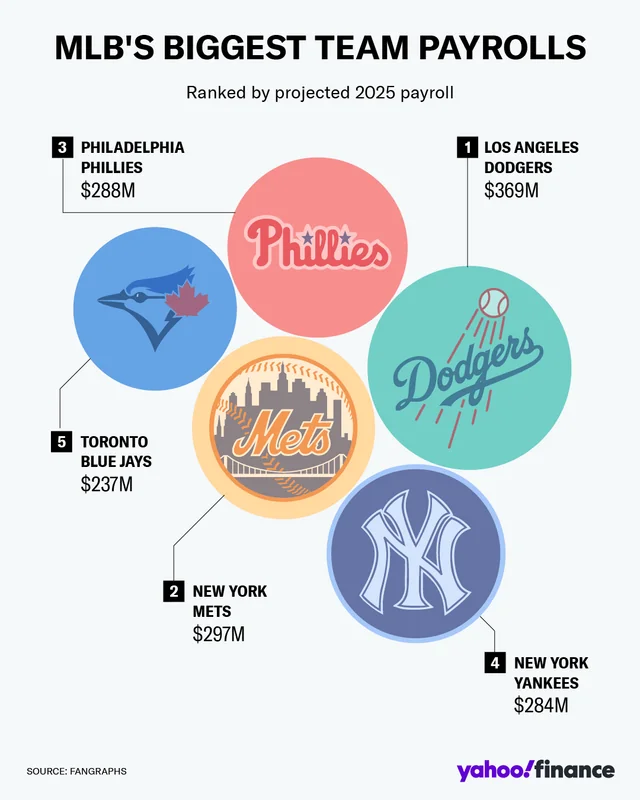
And yet the storm is gathering. The current collective bargaining agreement expires December 1, 2026. A lockout is not only possible, it is a near certainty. Owners are expected to push for what players have resisted for decades: a salary cap. And at the centre the argument stands the Los Angeles Dodgers, who just won back-to-back World Series championships behind the most financially dominant operation in sport’s history. The Dodgers’ spending has reached levels that threaten to unbalance the entire sport. Last year, between their payroll and a record $169.4 million luxury tax bill, their total expenditure for exceeded $476 million. To put that in perspective, the Dodgers’ tax bill alone was larger than the total payrolls of one-third of the teams in MLB. The “chasm” Billy Beane of Moneyball fame once lamented has become a canyon. In 2025, the payroll difference between the Dodgers and the Miami Marlins reached $407.6 million, the largest in modern history.
The following table illustrates the growing disparity in MLB’s economic structure since Peter Gammons penned his book, comparing the ratio of the top five payrolls to the bottom five across different eras:
MLB Era : Payroll Ratio (Top-5 vs. Bottom-5)
1975-1984 1.7
1985-1989 2.2
1990-1994 2.4
1997-2002 3.4
2017-2021 2.9
2022-2024 4.0
2025 4.7
This latest 4.7 payroll ratio disparity has galvanized a group of owners who are “ready to burn the house down” to implement some sort of salary cap. They argue that baseball is the only major North American sport without a salary cap and that the “system is broken”, noting that a top-10 payroll team has won the World Series in six of the last seven years. Conversely, the players’ union remains steadfast, the players view any version of a salary cap as a “red line” they will not cross.
Continuing to add fuel to the fire, this offseason, the Dodgers acquired Kyle Tucker on a four-year deal with an average annual value of $57 million, further cementing their dominance and sending every other front office into a collective existential crisis. The Tucker signing crystallized everything. The Dodgers, already champions twice over, already spending more than any team in the sport’s history, went out and added the best position-player free agent on the market. Tucker’s annual salary of $57.1 million set an MLB record, and the Dodgers paid a 110 percent luxury tax penalty on every dollar, meaning Tucker’s real cost was closer to $120 million annually. More than ten MLB teams’ entire payrolls.
The question then, is how much inequality can a sport tolerate before fans stop believing that their team has a chance and tune out? How much labour conflict can it withstand before audiences drift to other amusements? How do you preserve the beauty of the game while managing the ugly truths of its economics? Those questions will not be answered by nostalgia for another time, they will be answered, if at all, in bargaining rooms where the memory of 2025 Game 7 brilliance sits uneasily beside the threat of 2027’s silence. So, as we watch the 2026 season unfold, we must realize we are watching a version of the game that may be fundamentally altered by this time next year…
E) Toronto Blue Jays 2026…50th Year of Blue Jay Baseball …
So here come the 2026 Blue Jays, into their 50th season, carrying both the glow of a magical run and the scar tissue of how it ended. That combination can be a powerful fuel, yet it can also be a burden. Expectations in Toronto are no longer theoretical, no longer spring-training wallpaper, no longer the annual exercise in wish-casting that marked so much of the Shapiro-Atkins era. These expectations are earned now. This team came within inches of a championship. It goes into 2026 not as an intriguing club but as a battle tested one. The question is no longer whether the Blue Jays can contend, it is whether a club that built something as rare and specific as the 2025 chemistry can survive the inevitable challenges and changes that follow a deep October run.
Because teams do not merely lose Wins Above Replacement (WAR) in the offseason, they lose emotional architecture. The most significant shift is the departure of Bo Bichette to the New York Mets. His exit marks the end of the “Vlad and Bo” era that defined the late 2010s rebuild and the 2020s ascension. He will be missed. To offset his loss and build on the playoff run of 2025, the organization has pushed forward on its pursuit of a title, signing such high-profile free agents in the offseason:
- Dylan Cease ($210M / 7 years): The “strikeout machine.” Cease has logged 200+ strikeouts in five straight seasons. He provides the elite “swing and miss” stuff the Blue Jays are looking to be the new rotation anchor for years to come.
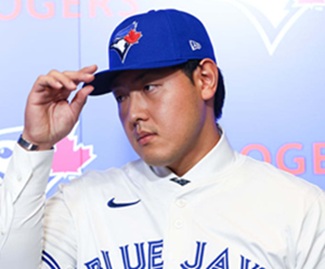
- Kazuma Okamoto ($60M / 4 years): “The Young General” from Japan. With a career 248 home runs in the NPB, Okamoto is tasked with replacing Bichette’s power. The question remains whether his defence at third base will translate to the Rogers Centre turf and if his offense can hit MLB pitching.
- Cody Ponce ($30M / 3 years): The reigning KBO MVP. A value-gamble who dominated in Korea with a 1.89 ERA and a fastball that touched 97 mph. He is the wildcard who could solidify the rotation while the others get healthy.
- Tyler Rogers ($37M / 3 years): The submarine specialist. Rogers provides a durable, unique look for a bullpen. His 1.3-foot release point is the polar opposite of Yesavage’s high-heat profile. They are looking at him getting the high leverage outs needed in the postseason.
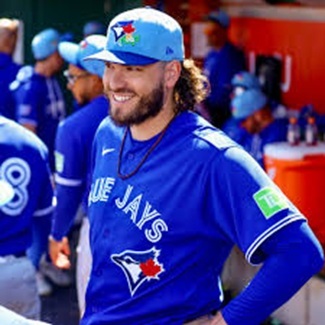
The financial commitment — more than $300 million in future obligations – underscores a willingness to capitalize on momentum. But the harder questions are not about the roster moves. They are about the Intangibles that was so much a part of the 2025 Blue Jays. The departure of Chris Bassitt, the Sage who mentored the young pitchers, and knit the team together, leaves a void that does not appear on any roster page. The same twenty-five-man magic cannot be reconstituted, because it was never about the roster, it was about the specific, unrepeatable convergence of those particular men at that particular moment.
To that end, only one team in the past sixty-five years has done what the 2026 Blue Jays are dreaming of: the 2014-15 Kansas City Royals, who lost Game 7 of the World Series in one October and returned to win it all the next. It is an almost impossibly narrow historical precedent. Yet the Jays have genuine reasons for optimism.
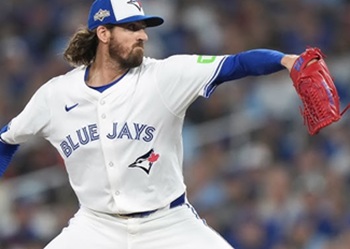
Vladdy heads into what should be the peak years of his career, motivated by a postseason performance that permanently altered how the baseball world sees him. A rotation anchored by Gausman, Cease, Yesavage, Ponce, Scherzer and Bieber have the potential to lead all of baseball in strikeouts. The core of the lineup – Springer, Guerrero, Kirk, Barger, Varsho, Clement – returns ready to lead a top five offense.
“I don’t think we’re going to try to be like last year,” Ernie Clement said in Spring Training. “We’re going to create our own identity”. That identity is now firmly built around Vladimir Guerrero Jr.’s peak years and a pitching rotation designed to “miss bats at an elite level”. The expectations are sky-high, with a franchise best 100 wins possibly within reach. For a team that was at a “breaking point” just two years ago after a last place finish, the goal is simple: find solace by finishing the job they were two outs away from completing.
Rob Sparrow is a Toronto marketing analyst and noted local authority on the sporting life.